 bNomadic
Leaving Home to reach the Roof of the World
The following is a page entry from On Road through the trans-Himalayas. To read complete travel memoirs and trip report, please visit here.
Chapter 2 of 22
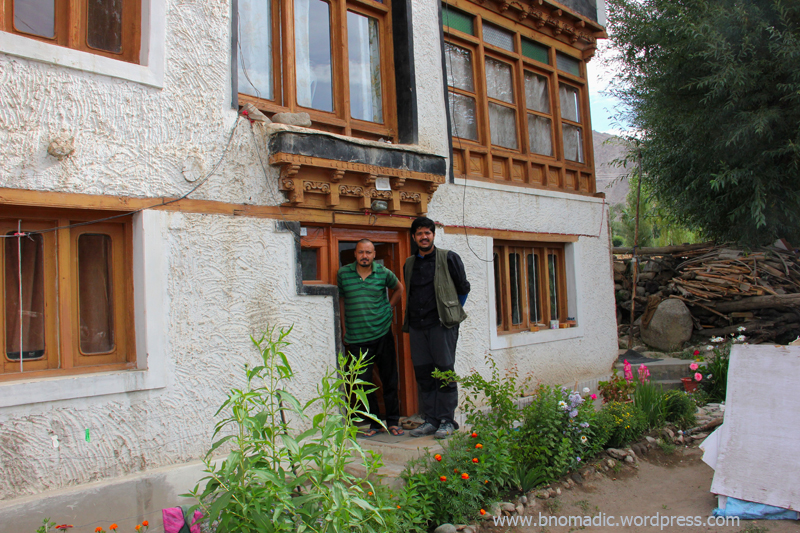
With Dorje at his home in Leh
Just as I was about to start for Chandigarh from Jind (Haryana), my hometown, I again faced a few unexpected events which were, mercifully, both welcome and favourable this time. I opportunely got an offer to travel along with a cousin of mine who was also well versed in driving Toyota Innova, our vehicle for the journey to the dreamland. As a consequence of the last-minute quandary, we had only three weeks left to finish our journey. Without losing any further time, I immediately set out for Chandigarh, our stop for the night, and picked my cousin on the way from Karnal. Before switching the engine on, I put the tachometer of my new Innova on zero reading at Jind itself. Powered by a BS-IV engine with intercooler, the latest addition to our garage had only done 4300 km but I was confident of Toyota’s reliability and Innova’s performance as it was a fourth Toyota vehicle and third Innova in our family.
Taking full advantage of the spacious Innova, within a shortest of time frame, we packed whatever we could manage that was felt to be needed for the journey. The list included a fuel-canister, fruits, packaged-water bottles, juice, biscuits, sleeping bag, blankets, extra winter wears, head gears, sandals, bathroom sleepers, etc. Howsoever jejune it may appear, it is my belief that if you have extra space left in your vehicle outstretch the checklist of essential articles and include items that meet ancillary needs. This belief later proved to be life protector at Pang in Ladakh.
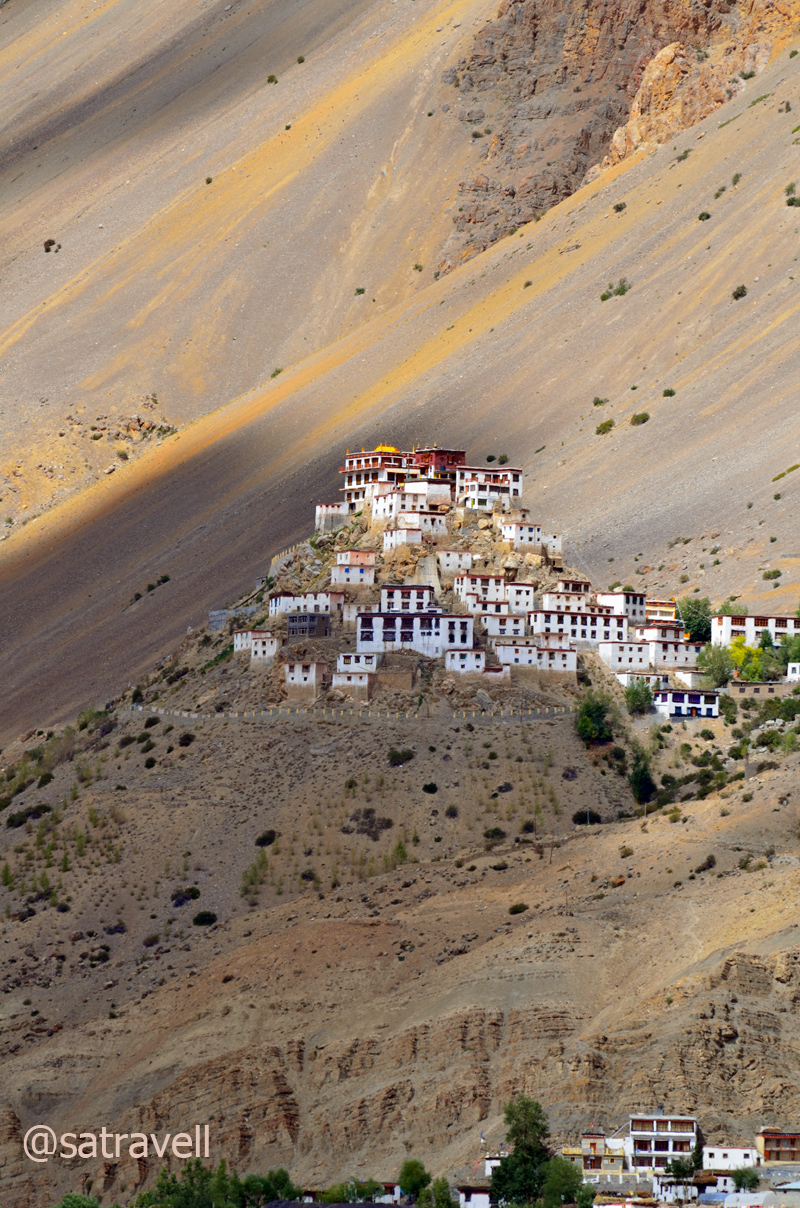
One of the most important Monastic schools in the Spiti Valley, the Ki Gompa is claimed to have been built in the eleventh century.
The idea behind staying in Chandigarh at the start of the escapade was to safeguard an opportunity to boost our supplies for the journey to the land of high passes. I particularly wanted to buy a book on Kashmir to understand the area, traditions, culture and its people. Although, Kashmir was not in our itinerary for the current trip but since Zanskar was so I held it to be a valuable brainwave to read something about its neighbouring region before we reach there. My cousin absolutely left it up to me to chalk out the route, night-halts and destinations. We both wanted to avoid the traffic at Rohtang and city-like humdrum of Manali, so I lost no time in deciding that we will explore Spiti first and join the Manali-Leh highway at Gramphoo after crossing Kunzum La. The excitement immediately got multiplied.
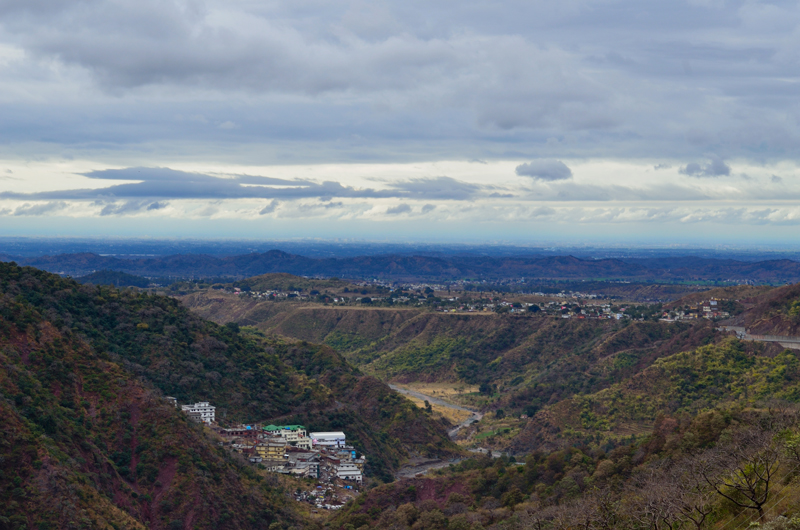
Shivalik Hills merging with the plains at Pinjore. Captured (later) from a point near Dharampur
However, a night-halt at Chandigarh would have meant a few additional hours to cover the distance for the next day. I could anyhow buy the book from Leh, our transit halt for the trip. Full of energy and excitement that night, we decided to drive up a maximum possible distance on the National Highway 22, lifeline of Shimla, Kinnaur and Spiti. The farthest he had been on this highway was Narkanda and for me it was middle Kinnaur. As both of us had enough experience of driving up the highway to Shimla and knew the terrain well, anyplace after Shimla was acceptable to spend the night. No sooner did we cross the Chandimandir cantonment than it started raining. It was bucketing actually, to say the least.

We saw no point in dragging ourselves on the highway in such a bad weather
Cousin immediately used contacts to book a luxurious accommodation at Dharampur for the night. After recharging our supplies from the main road market at Dharampur, we headed towards the extra comfy accommodation which was reserved for us and retired early after a quick dinner and informing parents about the plan. I also communicated to the cousin that this was to be the only accommodation for the next three weeks where we could enjoy the amenities offered by a plush property. Such niceties on a constricted budget may not always be possible everywhere. The favourable fact, however, was that we were venturing into the land of high passes in September, technically a tourists-off-season which meant greater discounts on accommodations.
You may also like to subscribe to the email updates, of the remaining chapters, by entering your email id in the sidebar.
Prologue to my trans-Himalayan Stroll
The following is a page entry from On Road through the trans-Himalayas. To read complete travel memoirs and trip report, please click here.
Chapter 1 of 22

Up there, Dragons are considered to be protectors of Buddhism. Photo-credit Sarabjit Lehal
From the time when I was studying in the university, jaunts to the roof of the world were planned on several occasions every season but nothing fructified. The highland-sojourn kept getting delayed on various accounts ranging from personal to professional to logistical. The closest I ever got to the region was in the monsoons of 2010 when I embarked upon a bicycle-ride to Leh from Shimla crossing Jalori pass. The expedition-ride had to be discontinued a little ahead of Jispa in Lahual, Himachal Pradesh after one of the teammates started showing symptoms of AMS and succumbed to the shortage of oxygen. Of the three-membered team, only one got to brave the odds presented by the treacherous terrain and rode solo from thereon to reach Leh as per the schedule.

Descending the Rangcha slopes after visiting the Kardang Gompa. Upper Keylong in the backdrop.
In between, the periodic strolls in the lap of Himalayas were restricted to the areas and surroundings of Kinnaur, Great Himalayan National Park, Manali, Garhwal and Kumaon, etc. The only way of appeasing the mind partially was to read and research more and more about the area. Having delayed the visit by more than seven years now, nothing except an extended visit would satiate the soul.
The long-cherished childhood dream of visiting the trans-Himalayan region was destined to see the light of the day in 2012. After dreaming as well as discussing all these years coupled with reading numerous travelogues and books on the area, I was ordained by the fate to travel the ancient-era trade-routes at this time of the year.
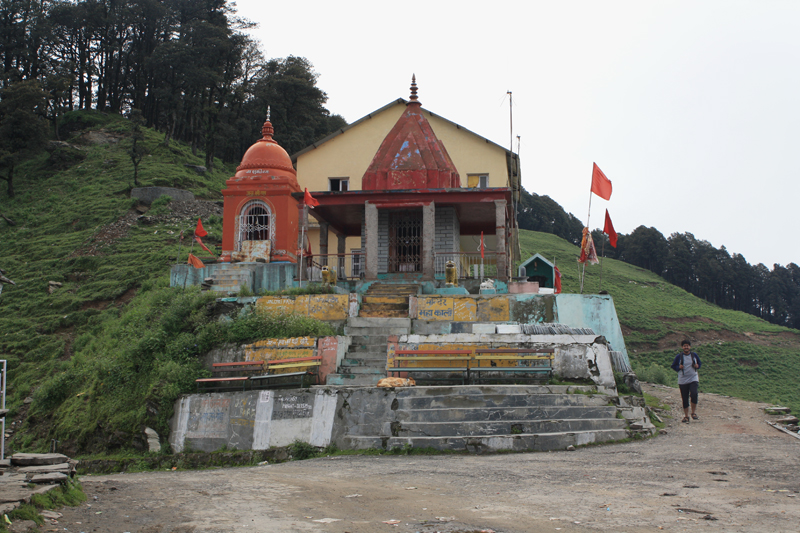
The temple dedicated to Goddess Mahakali marks the top of Jalori Pass
Although not everything happened as per the original plan and intention but this was one journey I enjoyed to the bottom of my heart. I promised myself to travel again the coming seasons armed with even better preparation.
The trip was initially billed to be a month-long expedition containing worthwhile exploration elements resembling short treks as well as camping, wherever required. A checklist of necessary and required items was prepared and routes were debated and a conclusion was arrived at in the form of a blueprint for the next one month. The areas to be covered were roughly identified as Lahaul and Spiti, Ladakh, Rupshu, Changthang, Nubra, Shyok, and Zanskar, etc. Owing to the delay in delivery of the 4×4 SUV by the manufacturer, second week of August was identified to be the perfect timing to departure for the expedition. In the meantime, me and my partner-in-crime for a long-time now, we both got ourselves to arrange for the items in the agreed checklist. By end-July, everything required was in the possession including the vehicle profoundly waiting for its first inspection and service before the commencement of our trip. I prudently selected music for the proposed expedition and the entire operation took several hours for me to load a 16 GB pen drive.
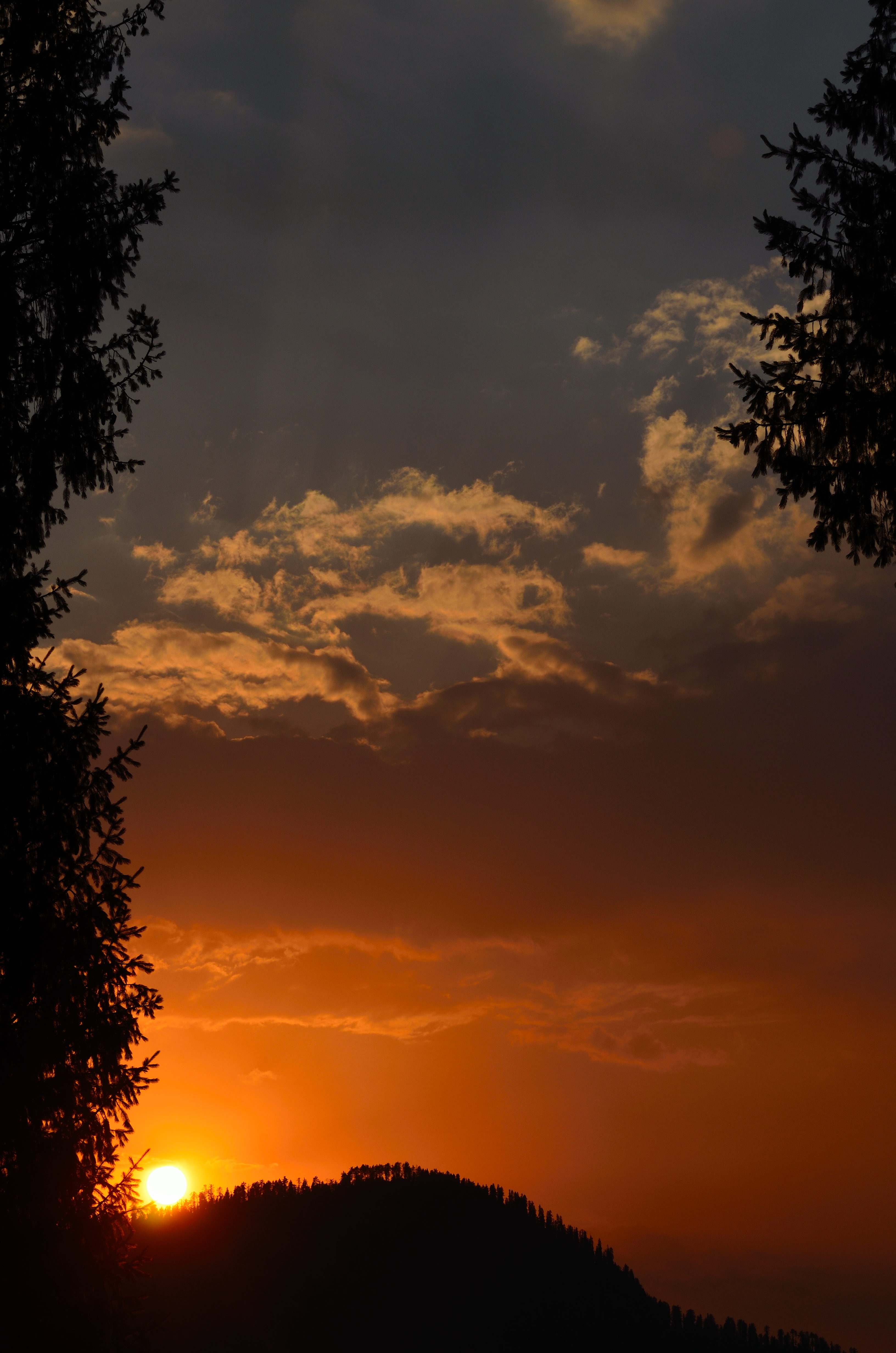
Sunset at Great Himalayan National Park
However, at the eleventh hour, a turn of few unexpected events in the family as well as work-life made it impossible for me to depart before August 30, 2012. Owing to his work-related obligations, the outcome was that my partner had to withdraw from this much talked about expedition. It was a gloomy period and I was simply unable to digest the very thought of having to postpone the expedition to the next season which would have meant a wait of one more year. The month of September being the last safe window for travelling to the trans-Himalayan region, I deliberated about travelling solo. Earlier, I have had a few occasions of travelling solo and knew both the excitement and responsibilities associated with it. Nevertheless, travelling solo to this part of the world necessitated a different set of planning and preparation which I immediately undertook.

The renovated Kardang Gompa, Keylong. One of the most important Gompas of Lahaul, the 12th century Kardang follows the Drukpa lineage
The plan was simple. Carry only the required stuff in a rucksack and ignore the gadgets and camera-kit for the time being. Travel in a shared cab, hitchhike and prefer public transport wherever available. I confirmed the same to Tsewang Dorje (James), my friend and classmate at the university, who is based in Leh and asked for his help in getting permits for the classified region in Ladakh and travelling to Zanskar. My brother booked me in a night bus from Chandigarh to Manali, where I would have taken a shared cab to reach Leh in a day. But the ticket had to be cancelled later on.

A bridge on the ferocious Bhaga River. The bridge connects the lower Keylong with Kardang village
(You may also like to subscribe to the email updates, of the remaining chapters, by entering your email id in the sidebar)
Bird-watching at Asan Barrage
It was during my recent visit at the Kalesar National Park when I finally got a chance to visit the Asan Barrage in Uttarakhand. It was on Sh Bharatlal’s, Forest Guard at the Sultanpur National Park, recommendation as a must-visit that I decided to visit the much talked-about wetland of the region. Situated at hardly a 20-min drive from the Kalesar Forests, it would, in fact, be a good idea to tie up this and nearby wetlands along with a visit to the National Park. I just wanted to do this when the moment finally arrived early this year.
Also known as Dhalipur Lake, the four km sq wetland created at the reservoir of the Asan Barrage is located at the confluence of Eastern Yamuna Canal and the Asan River, claimed to be Asmanvati of the Rigveda, in the Doon Valley which shares its borders with two other states – Haryana and Himachal Pradesh. From the NH 1, the diversion towards Ladwa from Kurukshetra takes straight to Yamunanagar from where the barrage is further 70 km towards Dehradun crossing Paonta Sahib on the way. Accessible from the Paonta Sahib – Dehradun road, the water-level in the manmade reservoir is controlled by the barrage.
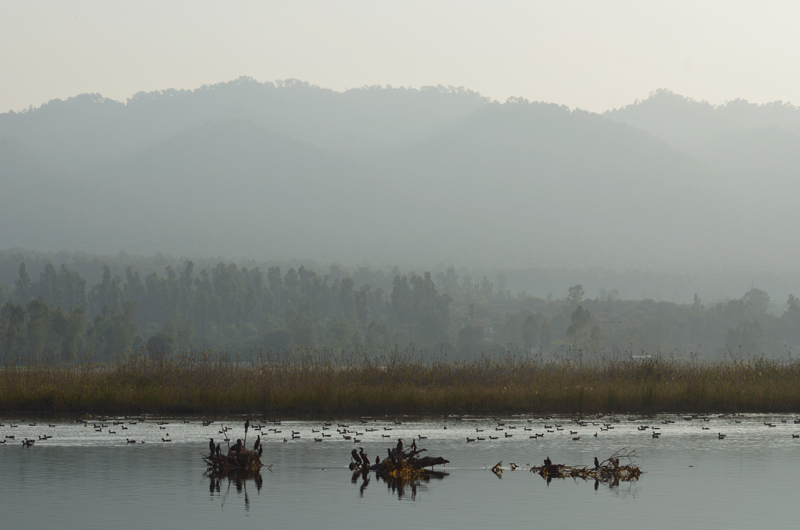
The depth of water at the lake varies from 3 to 20 ft.
From the time when the barrage was constructed in 1967, the water body has been attracting a large number of migrants, passage migrants as well as birdlife from the scrubland and woodlands of the adjacent forests. Although supporting birdlife round the year, the lake transforms itself into a true wetland when the water level goes down. Seeing its popularity grow among birdwatchers, the tourism development authority of the concerned government, the Garhwal Mandal Vikas Nigam (GMVN) made some efforts to develop this site into a picnic as well as tourist spot. Currently, the GMVN runs a cafeteria, a log-hut complex to provide accommodation to the visitors as well as a few adventure activities including water-skiing, rowing, kayaking and boating, etc. Unfortunately (but typically), most of the services provided by the GMVN at the site are nearly in tatters due to bad infrastructure management.

Cormorants sunbathing after drying their wings
Nevertheless, the average daily bird count at the wetland has been fairly large enough to appease the soul of a birdwatcher. The site was recently declared a Bird Sanctuary by the state government. Providing some natural hides as well as offering near-access, it was, in fact, an ideal site to photograph the waterfowls. The pedal-boats, though crumbling, make it possible to reach the small marshy islands and photograph the birds quite easily in their natural habitat. For me, the prized sighting of the wetland would remain that of the Pallas’s Fish Eagle which I spotted while sipping hot tea at the cafeteria, surrounded by a familiar menace of monkeys, by the lakeside.

Brahminy Ducks dominated the bird-count that day
As many as up to 240 bird-species, including a few endangered ones, have been reported in the checklist of the area including its immediate surroundings. The wetland has been known to be frequented by up to 53 species including 19 migratory birds from Europe and Asia. Begin winters and the migrants as well as passage-migrants to South India start arriving in large flocks. Common visitors include Shoveller, Ruddy Shelduck, Mallard, Coot, Wagtails, Pintail, Pochards, Gadwalls, Wigeon, Teals, Tufted Duck, etc. Birds of prey such as Marsh Harrier, Greater Spotted Eagle, Osprey and Steppe Eagle, etc. add to the magnificent biodiversity. Winters might be the most exciting season to visit but for serious birdwatchers the remaining time of the year offer just as exciting opportunities to see the local migrants like Cormorants, Storks, Cranes, Herons and Egrets, etc.
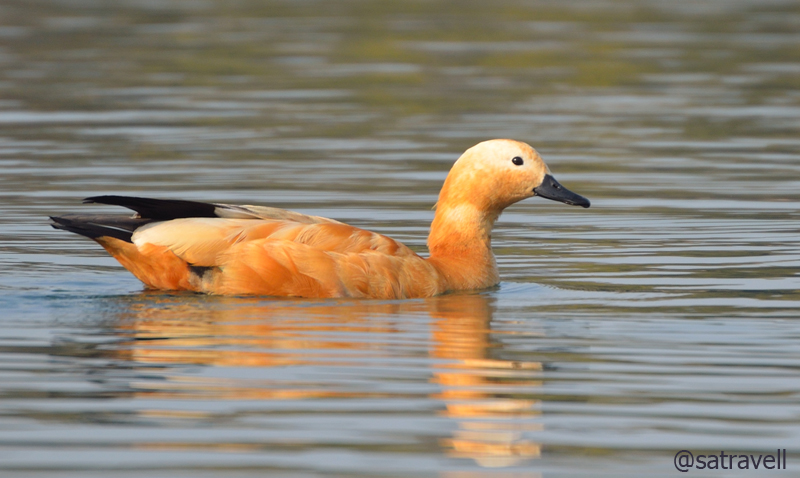
Ruddy Shelduck breeds in high altitude lakes in the trans-Himalayan region
The waters of the Yamuna could be accessed a couple of kilometres from the wetland. Other popular destinations within an hour’s reach from the site include confluence of Tons and Yamuna at Dakpathar, Asokan rock edict at Kalsi, Kalesar National Park, Kaleshwar Math, Paonta Sahib Gurudwara, Hathni Kund Barrage, Chuharpur Nature Park, Buria, Sugh, Bilaspur, Kapal Mochan Temple, Saraswati Udgama Sthal, etc.
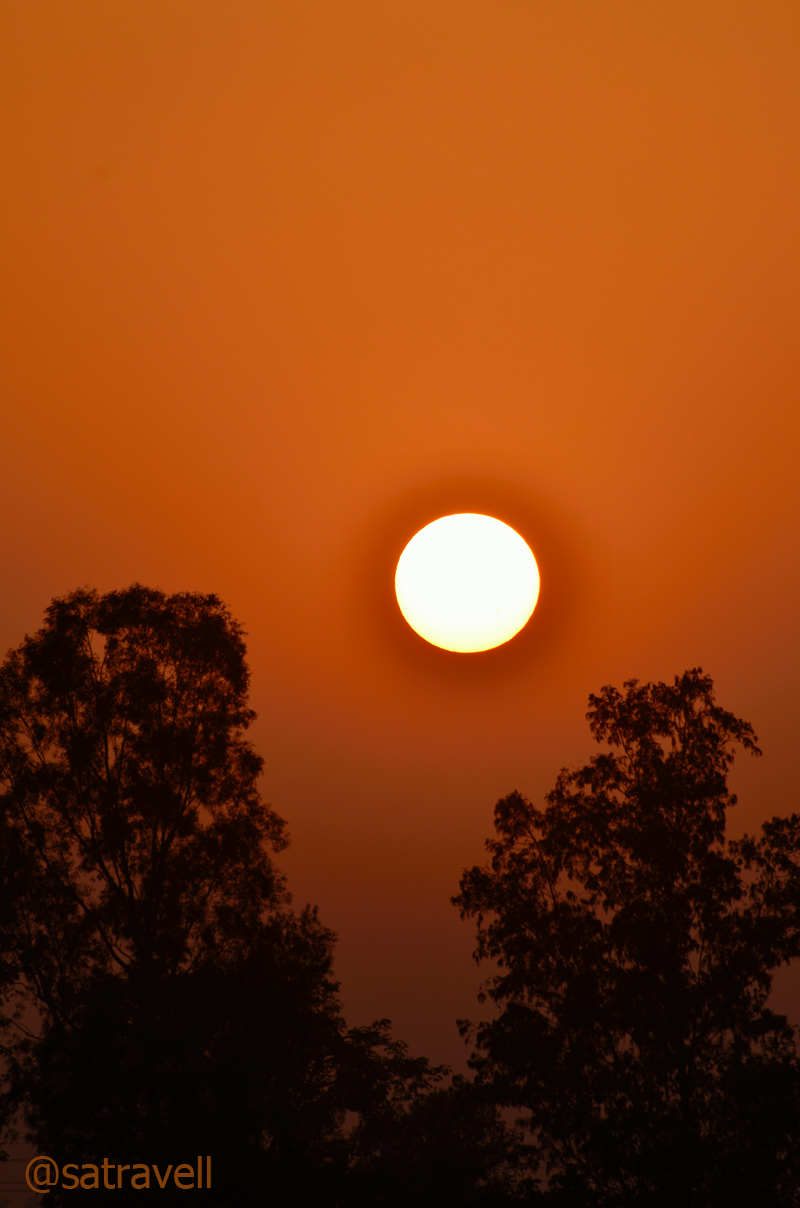
Sunset captured at the Yamuna riverbed
Hathni Kund Barrage – A lesser-known bird watching destination
During one of my recent visits to the Kalesar National Park, Haryana’s only Sal forest, I finally got an opportunity to visit the famed Hathni Kund barrage on the Yamuna River. Although, I had crisscrossed the barrage as well as the forest many a times before but a dedicated visit could only be made possible this time.
Located in Yamunanagar district of Haryana just before the Sal forest cover of Kalesar starts, the barrage marks the state’s border with Uttar Pradesh. The diversion towards Ladwa from Kurukshetra at NH 1 takes straight to Yamunanagar from where the barrage is just 40 km, a little aside the State highway connecting the district headquarters with Dehradun via Paonta Sahib, a popular pilgrimage of Sikhs.
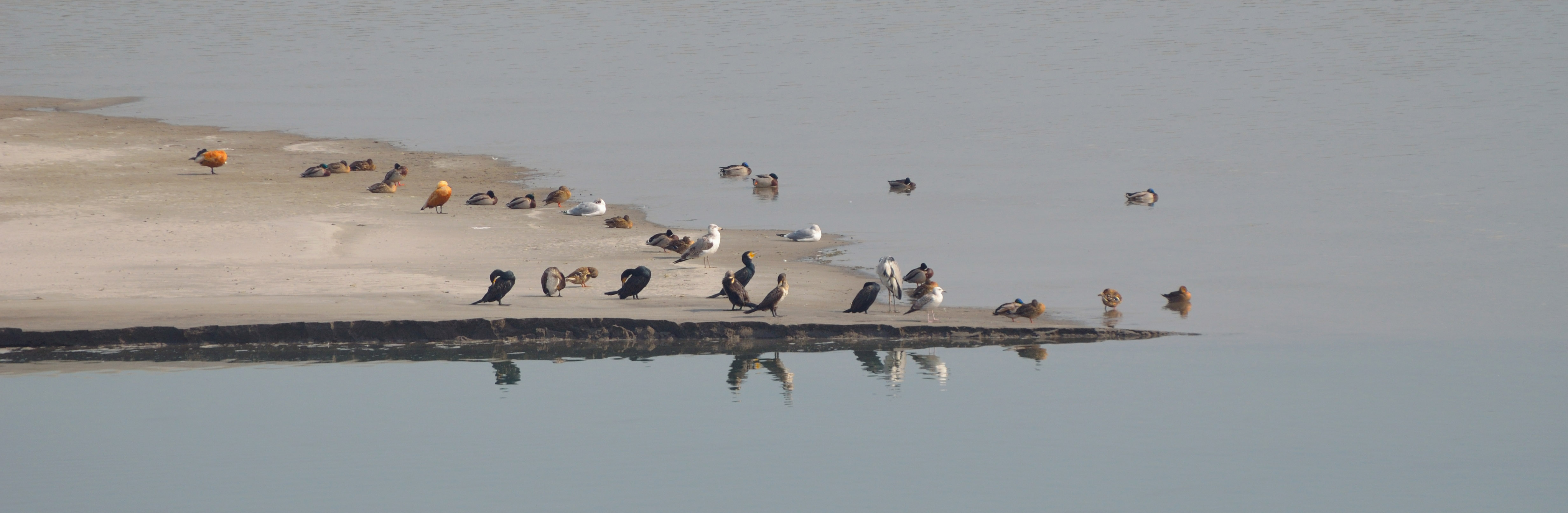
Waterfowls at the Hathni Kund reservoir
The folklore claims that an elephant, belonging to the personal cavalcade of the Mughal emperor Shahjahan, was drowned here (and hence the name). Legend has it that the emperor got the beast thrown into the Kund in the hope of retrieving the golden elephant in return, after someone told him that a priest had tossed the Paras Stone into the riverbed.
The Hathni Kund barrage, which diverts water into the Western and Eastern Yamuna canals, serves as a wetland for over 40 waterfowls including 15 resident species. During winters when water is mostly stagnant, the one-km-sq reservoir created by the barrage is known to attract a fair quantity and variety of migratory as well as resident waterfowls. Luck possibly was not on my side that day as the barrage surprisingly did not live up to its reputation as the quantity of the collective bird species was quite low. Nevertheless, I spotted River Lapwings in its natural habitat among others and the view from the barrage was quite absorbing. The foothills of the Himalayas, further afar, served as a link between the plains and the skyline.
Built on an elevated platform, Hatni Kund is not only a preferred bird watching site but is frequented by river rafters alike. As the river Yamuna enters the northern plains after meandering through Himalayas, crossing its last rocky lap at Paonta Sahib, the water-related adventure activities culminate at the Hathni Kund. As with other non-perennial rivers, such adventure activities are highly seasonal and flourish only when the flow of water is adequate (as in late spring). The waters of the Yamuna are redirected through a barrage at Hathni Kund and at Tajewala, located five kilometres further afield. The state tourism department bills these links as rafting course of the lowest grade or beginner level. Although, with regard to purpose, the British-era Tajewala barrage has been replaced by the recently constructed Hathni Kund barrage, the links are still very much functional. The waterfront at Tajewala could be combed for angling activities, after obtaining a special permit, specifically pertaining to Mahaseers.

The Hathni Kund barrage creates a one km sq small wetland
The seasonal camping facilities provided by the state tourism department have been discontinued and the best options to stay nearby include the Guest House of electricity department at the site and the colonial Forest Rest House at the Kalesar National Park. Having spent a couple of hours at the crystal clear waters of the barrage, I headed towards the National Park where I wished to spend at least three days.
Other popular destinations within an hour’s reach from the site include Asan Barrage, Bheemgoda Barrage, Kaleshwar Math, Paonta Sahib Gurudwara, Chuharpur Nature Park, Buria, Sugh, Bilaspur, Kapal Mochan Temple, Saraswati Udgama Sthal, Ban Santour, Adi Badri Temple, etc.
Kalesar National Park; Game Territory of Mughals
It was in mid-January of 2013 when I first got a chance to visit the Kalesar National Park situated in the terai region of eastern Haryana. Although the visit chanced upon at a time when winters were peaking but fortunately the sky was clear and the environment haze-free. Intending to spend at least three days within the purlieu of the park, I set off from my hometown in Jind, Haryana.
Located in Yamunanagar district of Haryana, the Park lay spread in the foothills of Shivalik Range sharing its border with three other states – Himachal Pradesh, Uttarakhand and Uttar Pradesh. The diversion towards Ladwa from Kurukshetra at NH 1 takes straight to Yamunanagar from where the Park is just 45 km on the State highway connecting the district headquarters with Dehradun via Paonta Sahib, a popular pilgrimage of Sikhs.

Located in Yamunanagar district of Haryana, the Park lay spread in the foothills of Shivalik Range sharing its border with three other states – Himachal Pradesh, Uttarakhand and Uttar Pradesh.
To make the best use of time at hand, I got a room in Kalesar Forest Rest House booked. Already familiar with the prevailing culture at such government properties, I got fresh vegetables and raw material for meals for the next three days packed from a roadside kiryana store in Jagadhri. Although, all such properties are sufficiently staffed with caretaker, cook, watchman, etc. but still, before moving in, one must confirm with respect to the availability of food. Lesser visited, as these destinations are, it is always recommended to get sufficient raw material for food as per the requirement. The cook will do the rest to provide the best possible service.
On the way, I made a brief stopover at the Hathni Kund barrage, located just before the dense forest cover starts, on the river Yamuna. A preferred bird watching site, Hathni Kund is known to attract a fair quantity and variety of migratory as well as resident waterfowls. Although water was stagnant, the barrage that day surprisingly did not live up to its reputation as the quantity of the collective bird species was quite low. Nevertheless, I spotted River Lapwing in its natural habitat among others and the view from the barrage was absorbing. The remainder of the drive from Hathni Kund to the FRH took less than ten minutes.
By the time the caretaker prepared tea, I took a quick walk in the FRH compound to make myself familiar with the area (mostly led by excitement). Situated in the SW fringes of the forest, the compound comprises two structures – a renovated colonial dak bungalow and a recently built multi-room building – beautified by a well maintained multi-layered garden. Commanding a sweeping view of the dry riverbed of Yamuna, the plush green colonial era FRH compound is one of the prime properties of the Forest Department of Haryana. From the FRH lawns, the ruins of a Mughal-era castle, frequented by Shahjahan during his hunting sojourns, could be spotted across the other bank of Yamuna. The region was hot favourite with Mughals as well as British residents to satiate their hunting inclinations.
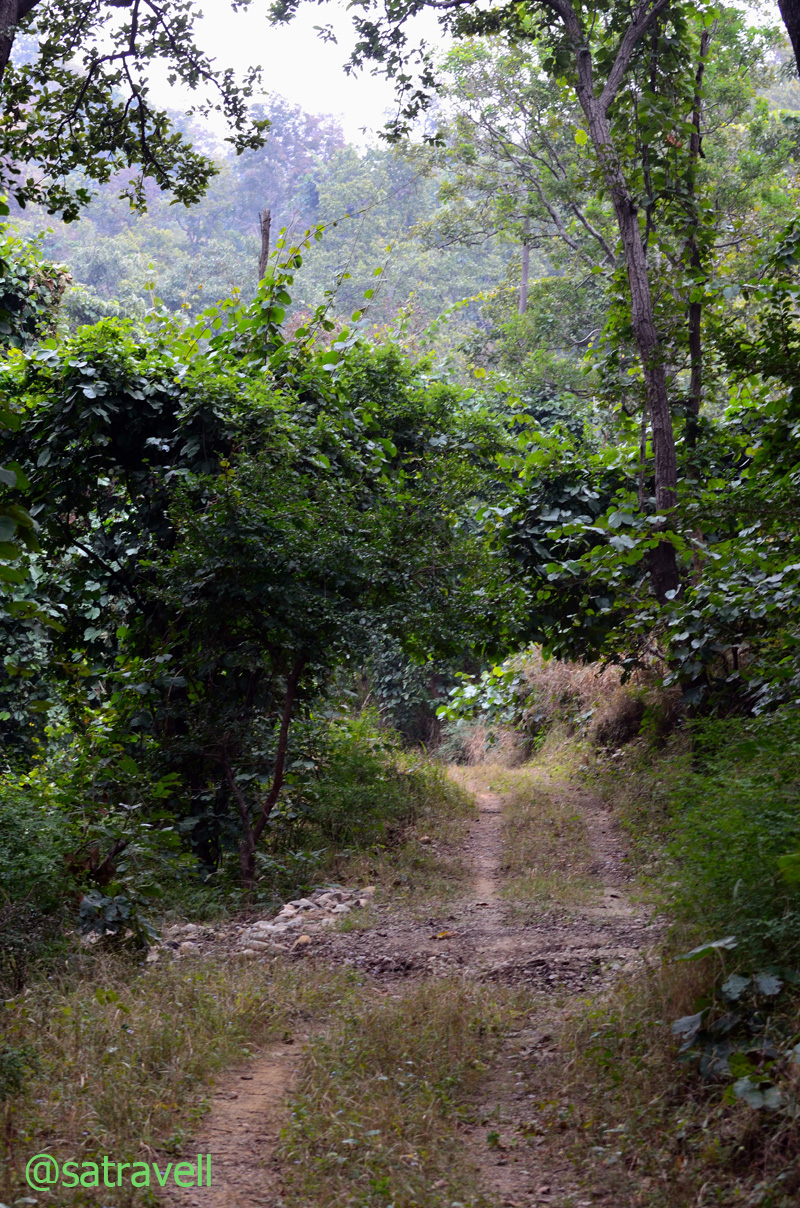
The motor-trail inside the Park
I had already earmarked the next day for the jungle exploration. So having sipped the hot tea, I headed towards another famous bird-watching destination Asan barrage located not more than 25 km from the FRH. Not only bird-watchers but the wetland created by the barrage attracts numerous bird-photographers as well. With GMVN facilitated boating facilities available, photographing the waterfowls has become easier. I was particularly smitten by the first sighting of Pallas’s Fish Eagle. Having spent a few hours at the barrage and captured a few sunset shots, I rushed towards the FRH crossing the Gurudwara on the way.
At the dinner table, I met with three forest officers who were undergoing a refresher course by the state wildlife department. One of them invited me for a jungle drive the next morning to which I promptly agreed. Later while serving the sumptuously-cooked evening meal, the caretaker asked me to be ready by 0530hrs the next morning and handed me a checklist of animals as well as birds which had been spotted inside the Park. Spread over 25,000 acre, the protected Kalesar forest was declared a National Park in 2003. The Park is named after the famous Kaleshwar temple, dedicated to Lord Shiva, located very near to the FRH.
Next morning by the time the incipient sunlight filtered in through the windowpanes, I was up and around with my camera as well as birding kit properly packed in the backpack. Having consumed a heavenly breakfast we left for the jungle along with a forest guard. The recently fabricated entrance gate was located a few kilometres ahead of the FRH, on the road to Paonta Sahib, right opposite the Kalesar Forest Range Office. There is not much formality but one needs to contact this office to get permission to visit the Park. The elephant safari which the department started a few years back, in order to promote tourism, is not operational any longer. Due to less interest shown by visitors, the elephant safaris as well as tented accommodations promoted by the state tourism department have been discontinued. The only way one could venture inside the Park is either on foot or in a self-driven jeep. A guide (usually a Forest Guard) is allocated by the department to accompany the visitors.
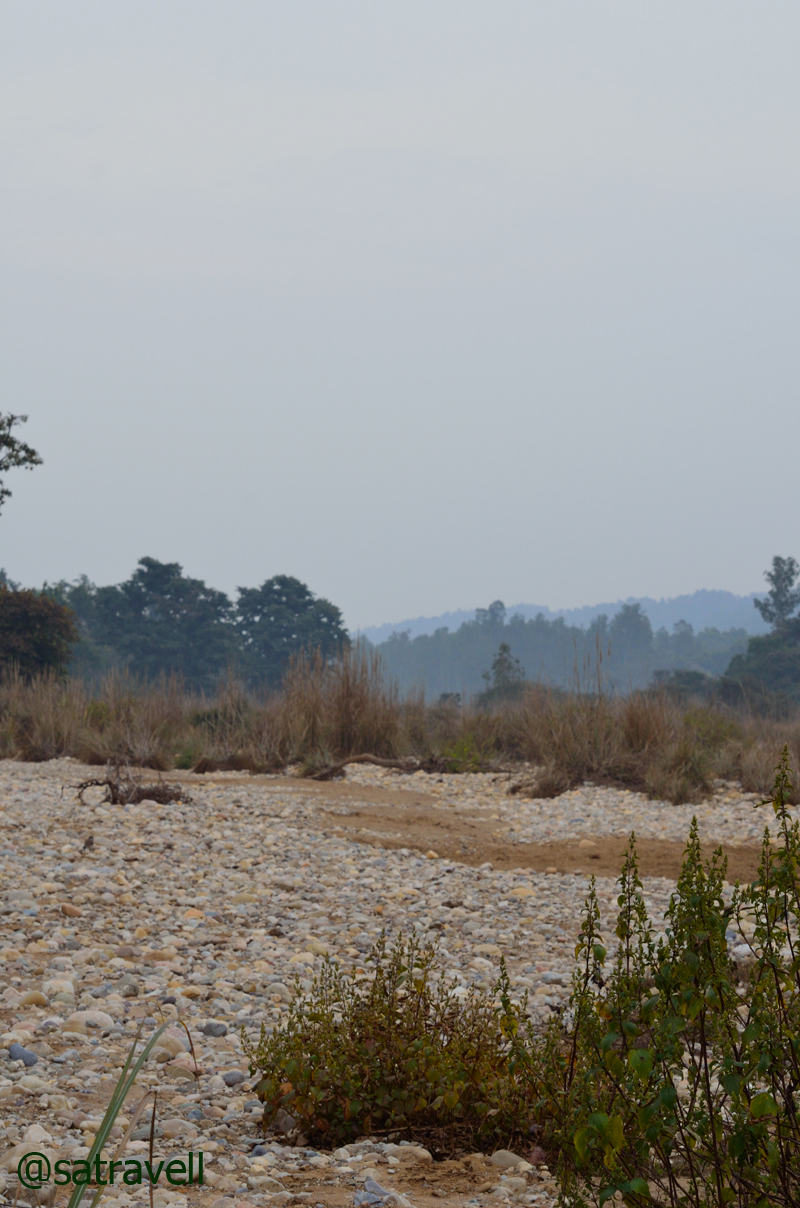
The dry streams come alive during the monsoon season
No sooner did we enter the Park than a small herd of sambar deer crossed the motor-trail. The forest manual says that the entire jungle is full of biodiversity with dense Sal cover which supports an amazing variety of bird and animal species including tigers. The eight-kilometre dirt-track culminates at an artificially constructed water pond to support the wildlife inside the Park. The area and the dry riverbed around pond is a good place to observe wildlife as was apparent from the pugmarks that we saw including those of a leopard. The forest department has strategically placed a few observation towers inside the forest, although, photography may not be possible from such high-rise points. We spotted an Indian muntjac, a small herd of Spotted Deer, a red jungle fowl among others from this area.
The surprising presence of fresh dung of elephant was a cause of worry for the officer who now had to institute a team to track the wild elephant and know its condition. Wild elephants from the neighbouring Rajaji National Park are known to venture into this area where they often create havoc. Later the officer told me that the Park is suffering from lack of funds from the concerned government. I was not surprised to hear his views on the failure of the authorities to protect the wildlife. Still I decided to find out the real truth and filed a few RTI applications. The response to most of those is still awaited.
Having parked our vehicle near the pond, we ventured, on foot, into the denser parts of the jungle. The chirrups which were unheard before worked to be a natural background score. The forest guard mostly kept us to the identified trails meandering from one range to the other. The hillocks forming the outermost layer of the Shivaliks comprises low sandstone and conglomerate rocks. Apart from the tall verdant Sal trees that constitute the lone Sal-forest belt of the state, other trees include Sain, Basooti, Rohini, Chhaal, Chirauli, Karu, Jhingan, Tendu, Kurha, Salai, Semul, Amaltas, Bahera, Sindoor. Cone-shaped anthills dot the landscape. Animals regularly claimed to be spotted include Leopard, Barking Deer, Sambar, Goral, Indian Porcupine, Spotted Deer, Wild Boar, Indian Pangolin, Indian Hare, Small Indian Civet, etc. Regular birds include Oriental Pied Hornbill, Black-headed Oriole, Scarlet Minivet, Common Iora, Coppersmith Barbet, Shama, Himalayan Barbet, Crested Serpent Eagle, Indian Pitta, Blue-tailed Bee Eater, Pale Harrier, Paradise Flycatcher, Red-whiskered Bulbul, Blue Whistling Thrush, Emerald Dove, Crimson Sunbird, Oriental White Eye, Indian Roller, etc. Over 300 bird species have been reported in this region.
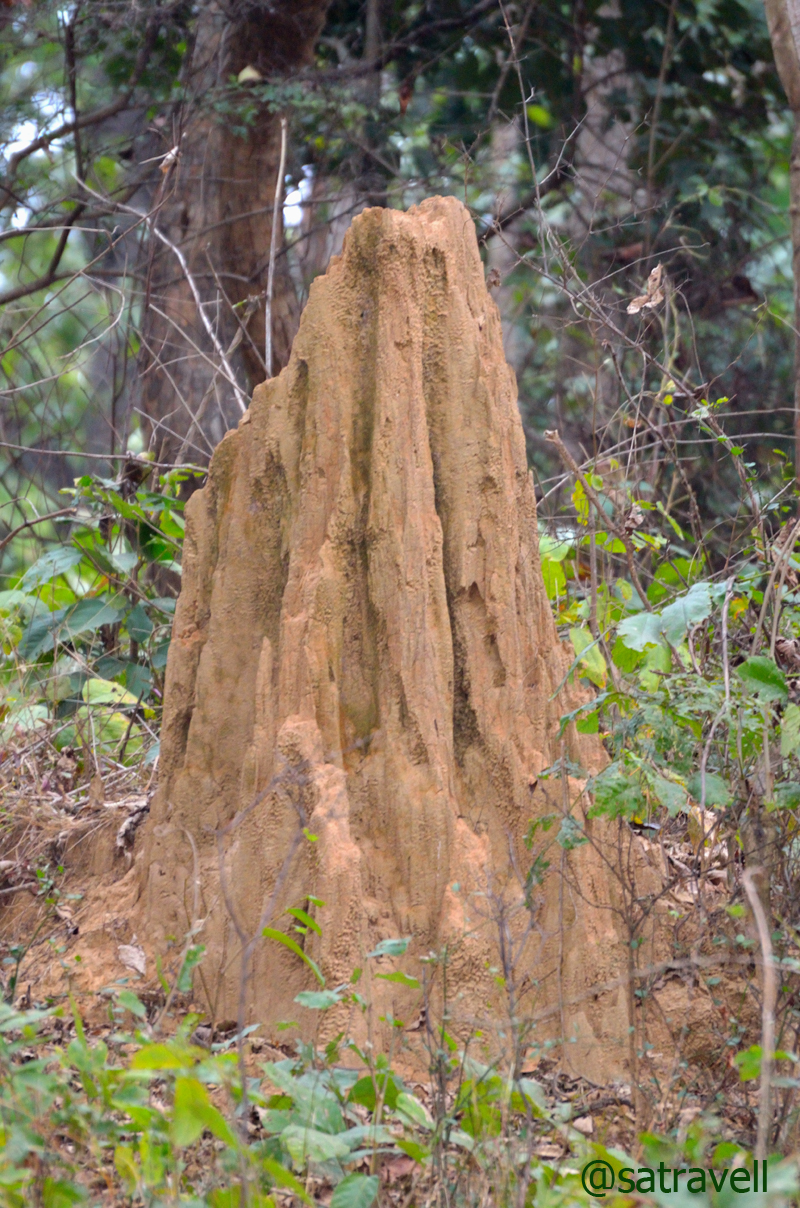
Cone-shaped anthills dot the landscape.
By evening we returned to the FRH. The day was well spent in the lap of nature. The next day was earmarked for visiting the nearby destinations including the Yamuna. Other popular destinations within an hour’s reach from the FRH include Kaleshwar Math, Hathni Kund, Paonta Sahib Gurudwara, River Yamuna, Chuharpur Nature Park, Buria, Sugh, Bilaspur, Kapal Mochan Temple, Saraswati Udgama Sthal, Ban Santour, Adi Badri Temple, etc. For those keen on stretching the sojourn, Mussoorie is just a couple of hours away.







 bNomadic