 bNomadic
Birding at Pong Dam Lake
Straddling the Beas River as it emerges out of the confines of the Himalayas, the Pong Lake lay limitlessly spread in Kangra district of Himachal Pradesh marking the state border with Punjab. Early this winter season in December 2015, I travelled to this – one of the most popular – winter migratory birdwatching destinations of north India. Starting from Chandigarh and taking pretty country roads through Punjab, I approached the lake from Talwara side. As one drives through the barrage, a wide-ranging view of the vast lake emerges. From here, the north-end of the lake is partially blocked by its prized island curiously called Rancer. Far in the distance, the snow-capped Dhauladhars announce their presence through a faint profile.
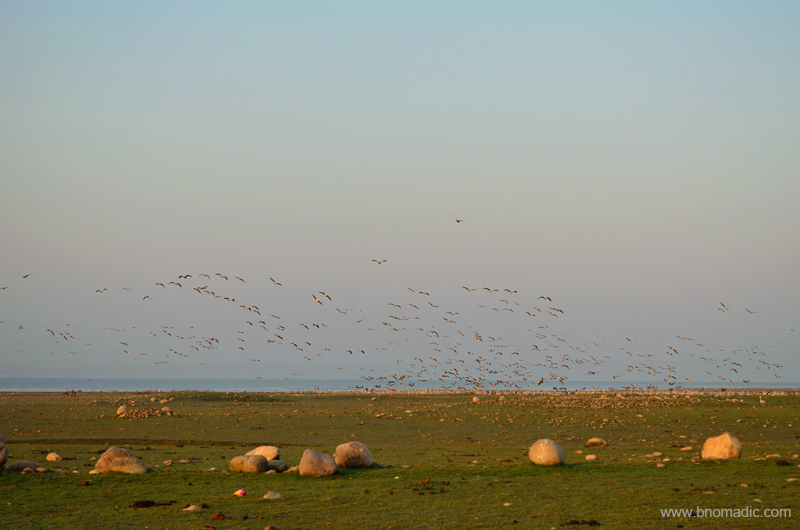
Morning at Pong flats; a skein of Bar-headed Geese. Please visit Flickr for more images of the region
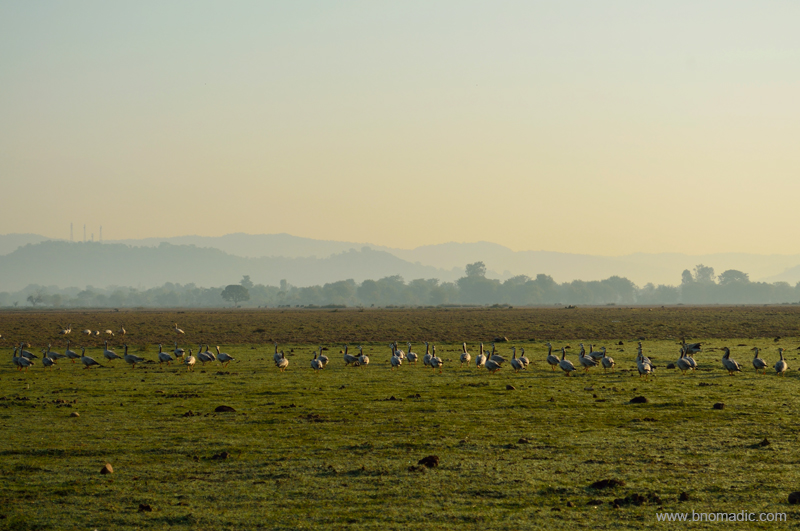
View towards Nagrota with Shivaliks in the backdrop; A gaggle of Geese marching towards the fields.

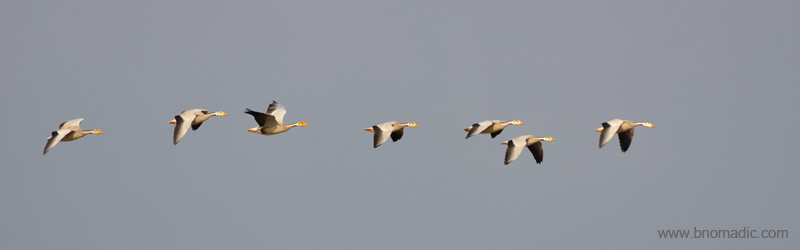
Over the years, the Pong wetland has become the largest single congregation destination for Bar-headed Geese not only in India but also in the world. More images from the region at Flickr

The Pong has been gathering international eyeballs after being declared a Ramsar Site in 2002.
Just next to the check post of the barrage, after the state fisheries department office lays the water sports and training facility run by the adventure institute ABVIMAS. I had my accommodation reserved at the state forest department rest house at Nagrota Surian, a sleepy village situated at the north-end of the lake, popular for its birding flats and trails. Driving at a leisurely pace, it took me almost two hours to cover the distance between the barrage and Nagrota Surian via Dhameta and Jawali. The Pong flats must hardly be four “vehicle-able” kilometre from the rest house.
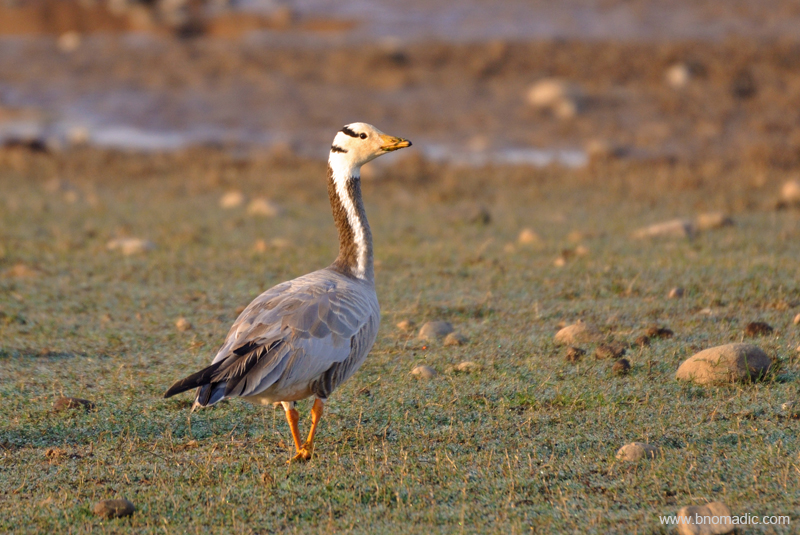
Bar-headed Goose, a hardy bird that has been observed flying over Everest. More at Flickr

A Woolly-necked Stork; also called Bishop Stork or White-necked Stork. More at Flickr
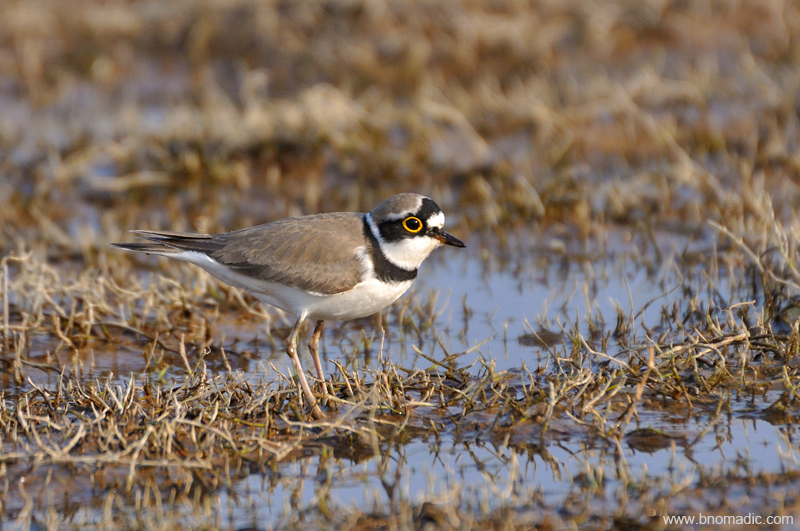
A Little Ringed Plover. Please visit Flickr Photoset for more images of the region

A Kentish Plover; It is smaller, paler, longer-legged and thinner-billed than Ringed Plover. More at Flickr
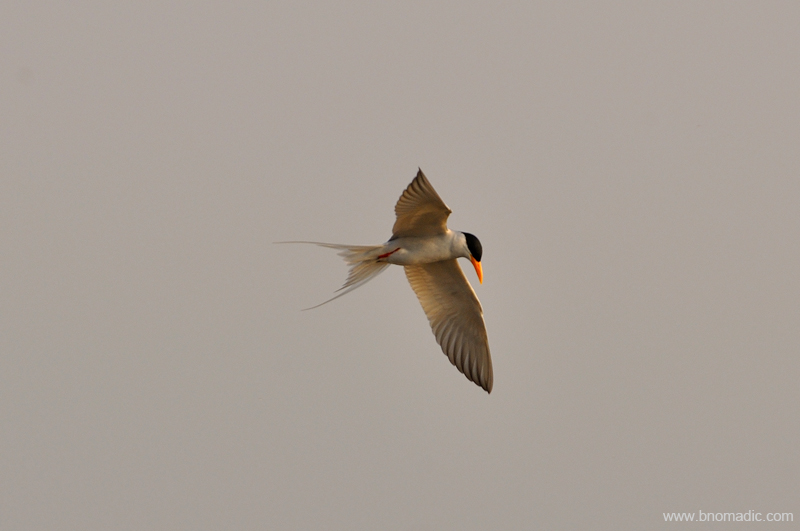
A River Tern; this guy feeds by plunge-diving for fish or aquatic insects in rivers or lakes. Its numbers are decreasing due to the pollution of their habitat. More images from the region at Flickr
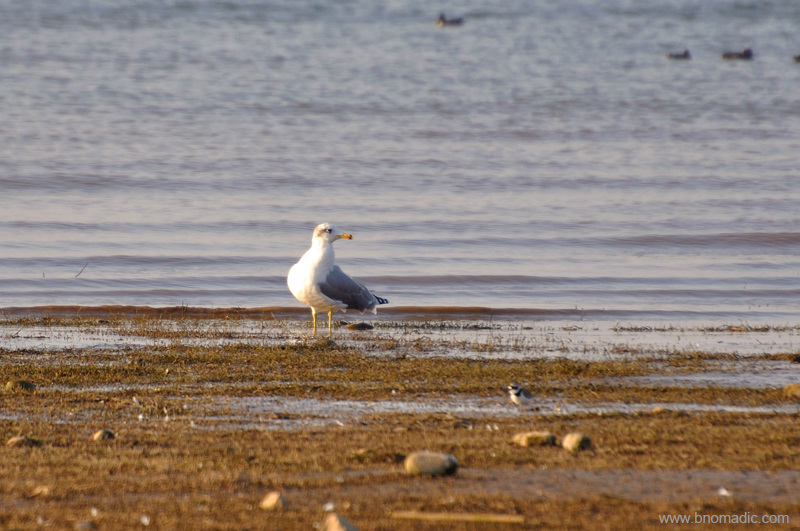
A Pallas’s Gull; This species breeds in marshes of southern Russia to Mongolia. More images at Flickr
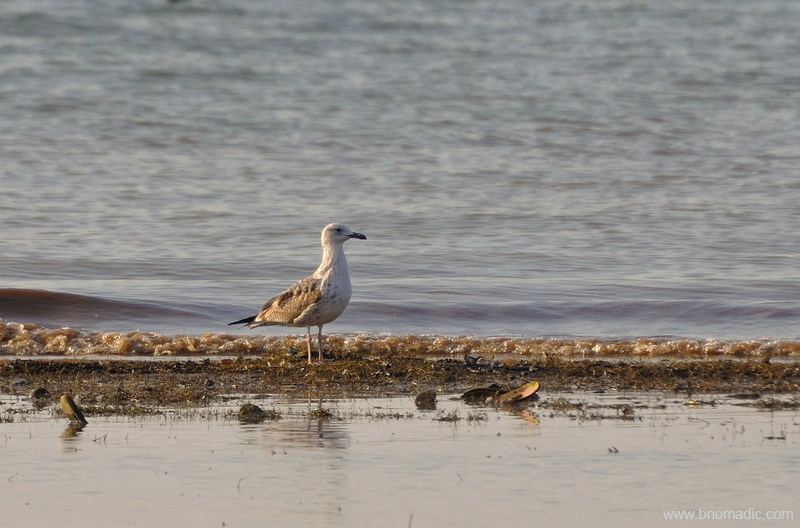
A Caspian Gull; This bird breeds around the Black and Caspian Seas extending across Central Asia to north-west China. Please visit Flickr Photoset for more images of the region.

A Black Kite. More images at Flickr
Insofar as birding is concerned, for the next one week or so, I’d get up early morning to reach the Pong flats before fishermen would. Having spent some good bird-full hours by the shoreline of the lake, I’d head back to the rest house for breakfast only to return to the shoreline by early evening. The route would take me through the bustling market and residential colonies of Nagrota Surian, an erstwhile trading base of Kangra region. The scenic prettiness of the landscape climaxes towards evening; with the vast stretches of the lake against the backdrop of setting sun on one side and snowy outposts of the Dhauladhar Range glittering in the evening light on the other.
As the waters of the trans-Himalayan region along with wetlands of Europe, North and Central Asia gets frozen every winters, flocks of waterfowls that breed in those areas in summers migrate to plains located south of the Himalayas. Also called Maharana Pratap Sagar, this vast reservoir that was primarily constructed in 1974 as a check dam to store water for irrigation as well as to generate power, is thronged by no less than 1,50,000 avian visitors on average (2010 two-day bird count). The emerging wetlands gathered international eyeballs after it was declared a Ramsar Site in 2002. Every winter, the shoreline of the lake could be seen abuzz with flapping wings and cackling sounds of varieties of waterfowls including Bar-headed Geese, lake’s most regular date. The stagnant fresh water adds to the concentration of organic matter, worms, insects or molluscs and other tiny creatures that make this wetland most popular among winged visitors particularly Bar-headed Geese whose visiting population at the lake constitute more than 40 per cent of its population in the world. Not only this but rare species like Indian Skimmer, Whooper Swan, Red-necked Grebes, White-fronted Geese along with many others of vultures, falcons and waders, etcetera have been recorded.

A faint profile of Rancer island from the shoreline. More from the region at Flickr Photoset

View from the Meenu Khad at sundown. More images from the region at Flickr Photoset
With winters setting in, the receding shoreline of the lake near the villages of Jawali, Dhameta, Dada-Siba, Haripur, Guglara, Harsar, and Nandpur as also of Nagrota-Surian provide ample opportunities to a birdwatcher. Full of life, the nutrient-rich mudflats along the shore-line attract birds such as lapwings, waders, egrets and herons, etc. even as the open waters prove to be a heaven for ducks, grebes, geese or cormorants. The drier sand banks and waterside vegetation and shrubbery attract curlews, warblers, babblers, munias, kingfishers, moorhens and predators, etc.
Back at the rest house, the caretaker tells me that when the waters begin to recede, the villagers seasonally farm the land in the periphery of the lake. This along with commercial fishing and the grazing by nomadic herds of cattle is reasonably effective in attracting birds as long as everything is done below a tolerable level. The villagers are increasingly becoming more aware of conservation.

Lakeview from a partially exposed Bangoli Chook. More images from the region at Flickr
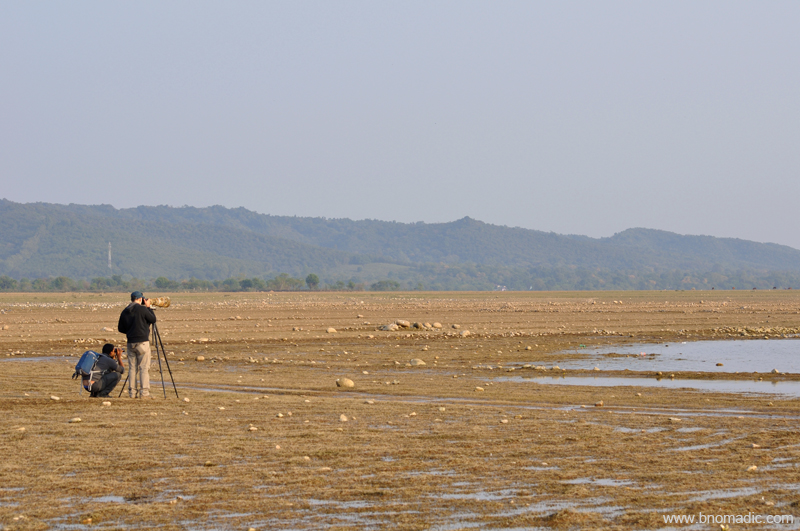
Advisable to carry Binoculars or Spotting scopes and a telephoto (if interested in photography)
Also, just if you thought that Pong’s travel charm is limited to birding, there are a number of places of cultural and mythological importance within the vicinity of the lake. And although I didn’t partake in activities like boating, angling or water sports but the caretaker mentioned that such activities not only require permissions through official channels but some expertise as well. The popular islands of the lake Rancer, Karu, Rajeli, Jattan Da Kuwal, Dhanderh that are good and reclusive for birding, offer equally good prospects for boating.

Magical Pong; possibly one of the best lakeside sunscapes. More images from the region at Flickr

Landscape northfaced in an overcast weather; a faintly glittering profile of the Dhauladhars.
The official checklist of the Pong mentions close to 415 species of birds in addition to many animals, reptiles and fishes. Here is a list of birds I saw at Pong: Northern Lapwing (a lifer for me!), Bar headed Geese, Ruddy Shelduck, Sarus Crane, Coots, Wagtails, Pied-Kingfisher, Black Kite, Brown Headed Gull, River Terns, Purple Swamphen, Eurasian Wigeon, Northern Shoveler, Cormorants, Greater Coucal, White-breasted Waterhen, Little Grebe, Northern Pintail, Common Pochard, Gadwall, Spot-billed Duck, Common Teal, Bank Mynas, House Crows, Pipits, Larks, Sandpiper, Cattle Egret, Snipe, Red-wattled Lapwing, Little Egret, Great Egret, Black Kite, Black-shoulder Kite and plus some Herons.

Nomadics! :-). Please visit Flickr Photoset for more images of the region
Postlude

The following post is a part of the “Kailash Mansarovar Yatra” Blog Series Into the Sacred Space. To read complete travel memoirs and trip report, please visit here.
As we were being ushered out of the plane through to the corridors and lobby area of the Terminal three of the New Delhi airport, I firmly hoped that the journey to the Kailash Mansarovar must have madly induced the Himalayan addiction in at least a few of us. Loyally encompassing the majestic powers of nature, the Himalayas are spiritually safe passages crafted by nature for us to support our Journey of Life. Readers of bNomadic would discover corroborative evidences sprinkled in various posts of the blog to this inspirational belief related to the Himalayas.
Walking through the corridors of the airport; carrying my feebly packed untidy backpack smeared with the trans-Himalayan dust, I felt a pure contentment of having completed a journey that I always dreamed of. Compared to the previous century explorers and travellers, ours was of course a modern (and comfortable) way of undertaking this journey. I almost felt that there is nothing else left on this planet where I needed to reach but then there are other hidden gems and corners waiting to be explored in the Himalayas.

Glittering Gurla Range towering above Barkha Plains. This and the featured image (from Barkha) of this post by Rita Willaert. I wish to express my most sincere gratitude to the noted photographers Rita Willaert and Jen Reurink who kindly shared and consented their photographs to be used on bNomadic.
Minutes later, as everyone waited for their bag to bounce along on the conveyor belt, I noticed a massive poster on the wall adorned with a quote from Aitareya Brahmana, an ancient Hindu text, “There is no happiness for him who does not travel…” Now this was a religious conformity to the fact that to travel is to realise the love with inner self. We need the Kailash type serene and calm refuges in a world of storm that we go though in our routine mundane city life. Withdrawal to a natural and Godly retreat in the Himalayas with such a purpose in mind is nothing but a sign of absolute wisdom and strength.
The writings of the famous spiritual explorers of the Himalayas; from Swami Pranavananda to Paul Brunton reflected that if we purposefully withdraw ourselves to a Himalayan sojourn for a while so as to reconsider our desires and survey our courses and if we use the leisurely opportunity to address our internal agitations as well as refine our instincts, we cannot be doing wrong. And with this very thought in mind, I continue to explore and reach more hidden corners of the Himalayas located further afar.
Not only my inner self but as I write this last post of the Kailash Mansarovar Yatra blog series, almost eight months after the yatra happened, I see a lot of aesthetic changes around me at home. From my workstation to lounging area or my bedroom, living room or drawing room, the walls, shelves and tables are now adorned with photo frames or souvenirs from this yatra.
On a concluding note, I’d admit that our yatra through the forbidden country – the land of snows and monks – had all the “elements” of Himalayan travel. And as Heinrich Harrer would recall, “For romantics, there was even the attraction of the blue poppy that flowered in secret beyond the mountains!” No wonder missionaries, intellectuals, adventurers, travellers and scientists were always keen to explore the secrets and mysteries of that country. With this thought, I’d request each one of you to constructively devour Himalayan adventure, discovery and knowledge in your own ways.
Here follows a recap of the yatra in this small video. The background score belongs to Sahil Jagtiani.
Thanks. Happy travelling.
Back to the Plains

The following post is a part of the “Kailash Mansarovar Yatra” Blog Series Into the Sacred Space. To read complete travel memoirs and trip report, please visit here.
The weather was indeed very bad that day. As we left the Governor’s House at Gangtok, our driver informed us that the road ahead of Teesta has been blocked since morning because of multiple landslides. The last minute plan was to take a diversion to Darjeeling from Teesta and reach Siligudi via the touristy hill station famed for its tea cultivation. The diverted route was of course a tad lengthier but was more scenic and greener. Crisscrossing the narrow (but safe) roads passing through tea estates, we reached our guesthouse at Siligudi just before dinner time. On the way down from Gangtok, the highway-bound fun was limited to occasional tea or refreshment stops.
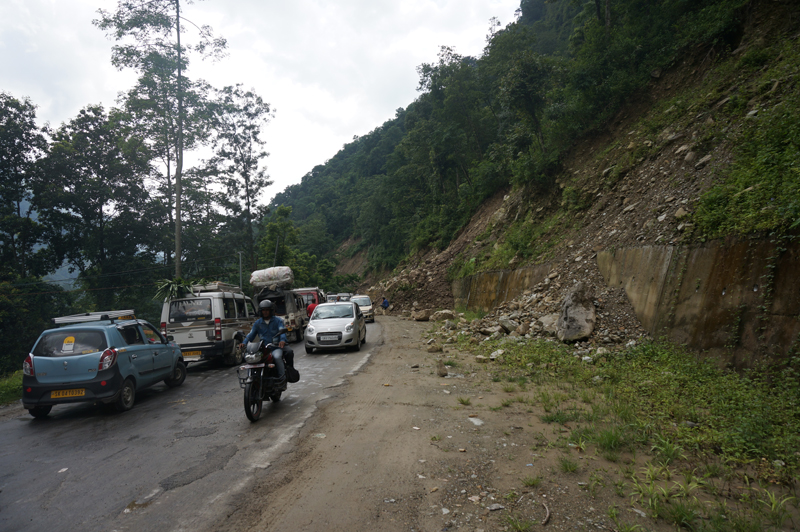
Traffic Jams because of landslides triggered by incessant rains
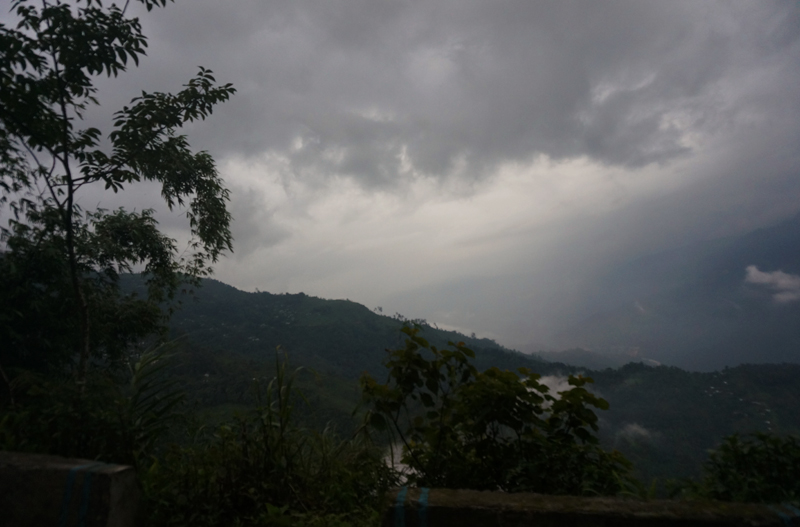
Overcast weather
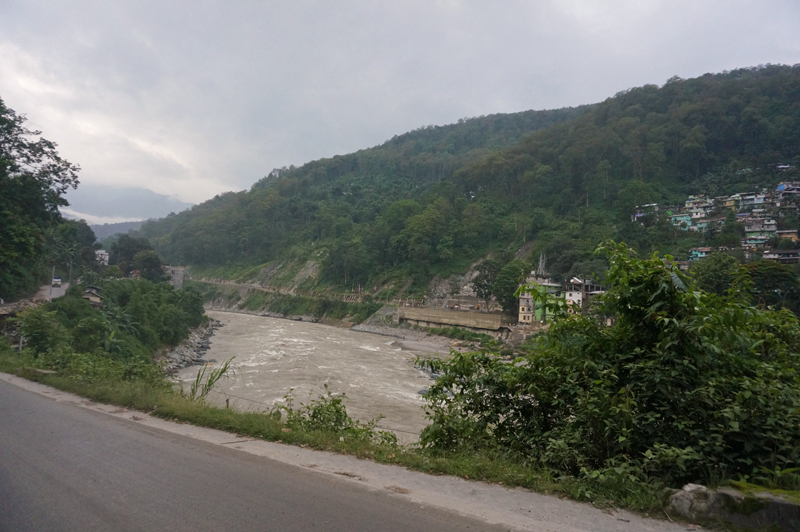
A little before Teesta
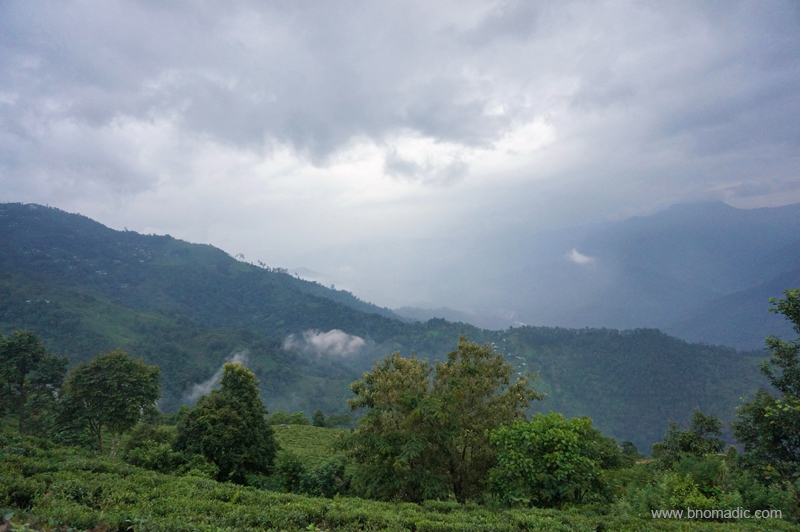
The verdant Tea Estates of Darjeeling
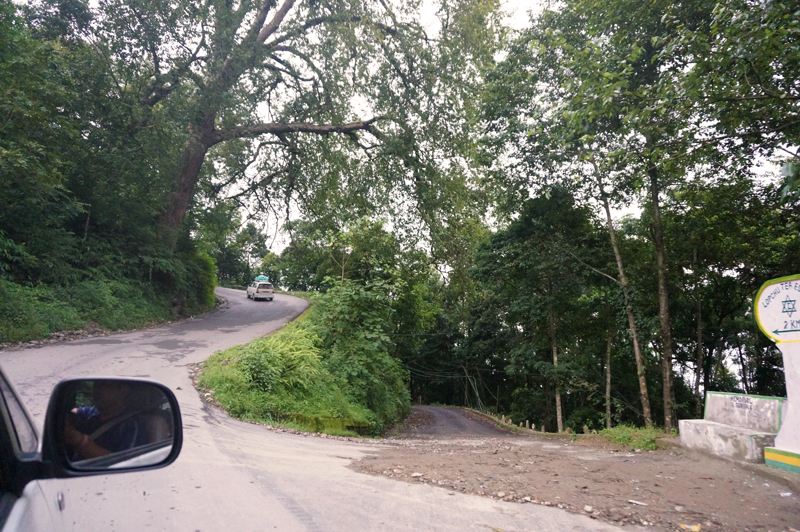
The narrow highway to Darjeeling

Tea plantation workers with their cane baskets
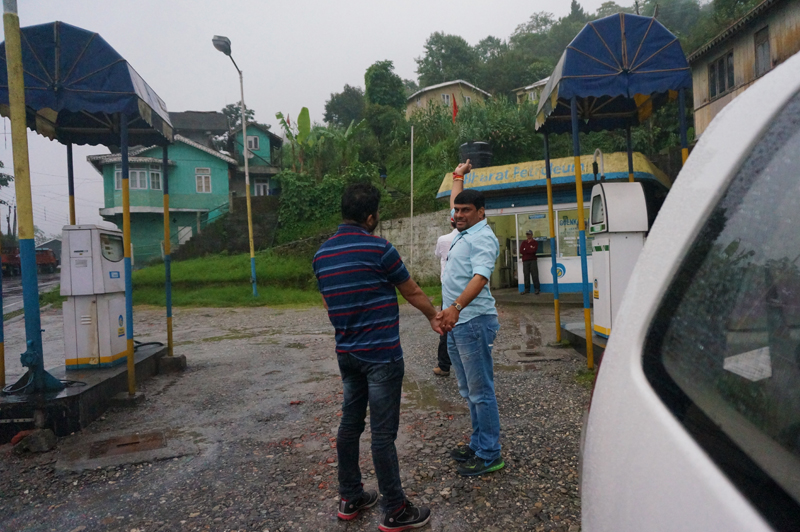
A little before Siligudi; at a fuel station
The Bagdogra civil airport was hardly 10km from the guesthouse we were staying in at Siligudi in W Bengal. The plan of the host Sikkim Tourism Development Corporation (STDC) to put us up so near the airport seemed to make sense as the decision was expected to save some precious time. We unhurriedly reached the airport and were still hours ahead of the scheduled departure time. Outside, the luggage committee honouring its commitment one last time made a final count of the bags. The yatra had come to a close sooner than we had expected it to be.
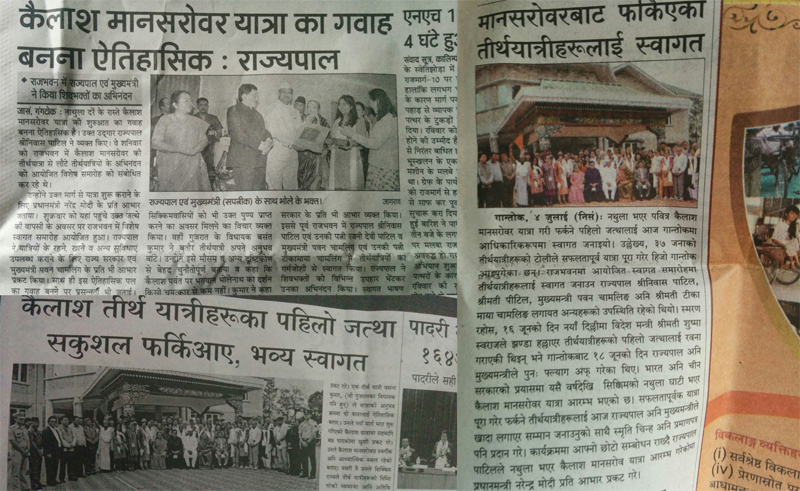
Media reportage next day in vernaculars
The flight journey from Bagdogra to New Delhi takes about 90 minutes in the air. The weather outside was free of any turbulence. Inside the aftereffects of the KM Yatra emerged in various colours and forms. From spiritual talks to backbiting-related gossips, the air-travel had it all. Plans were made and discussed for frequent get-togethers, social gatherings as well as to make another journey to the Holy Land. I was already planning upcoming excursions as the flight began to hover over the NCR region. Down below, the matchbox apartments and other skyscrapers sounded a sort of warning bell. Our ingression into the real world seemed inevitable now. This was supposed to be the figurative end of our dream journey.
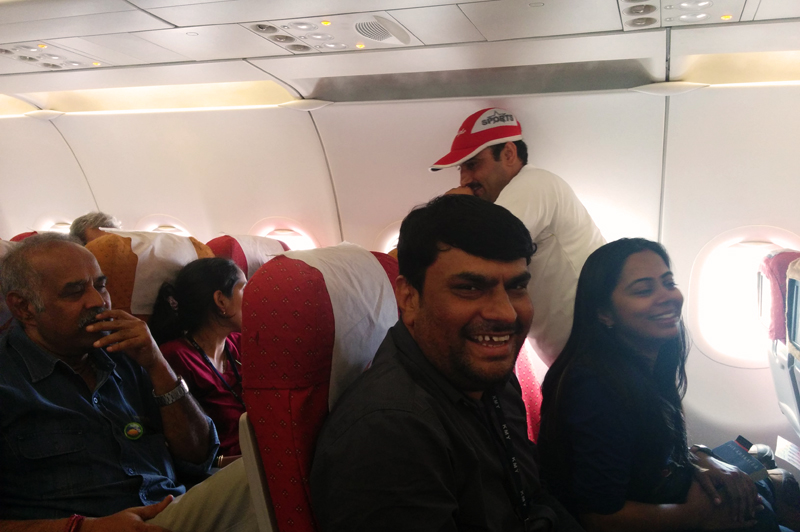
Inside the Air India flight
As the flight prepared to touch down, Babaji raised the final holy cry of Om Namah Shivaya. Enthusiastically, the group joined. Already intrigued, a few of the passengers welcomed the war-like cry with folded hands. As a group, we had paid our obeisance to the Holiest of Lands and travelled some great distance. I hoped that we all are going to travel and live this yatra forever. Once you have travelled and made a journey as epic as this one, the voyage definitely is never going to end. This journey was going to play out over and over again in our peaceful inner spaces. Both mind and heart could never get detached from such a journey.
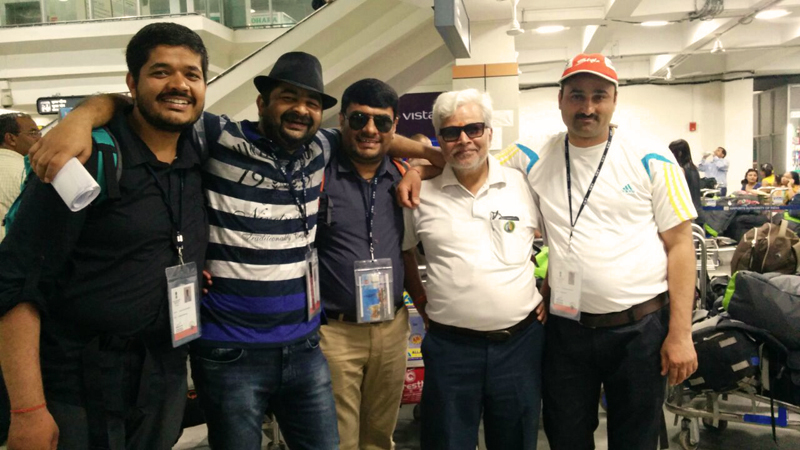
Mandatory KMY Groupfie at the airport
As we were being ushered out of the plane through to the corridors and lobby area of the Terminal three of the airport, I hoped that the journey to the Kailash Mansarovar must have madly induced the Himalayan addiction in at least a few of the groupies. Slowly the group lumped around in the newly designed luggage gallery of the airport. All of us huddled one last time and recorded groupfies. Quickly enough, one by one everyone left for their home after exchanging due formalities of parting. Outside our families awaited to receive us.
The Festivities Around

The following post is a part of the “Kailash Mansarovar Yatra” Blog Series Into the Sacred Space. To read complete travel memoirs and trip report, please visit here.
Having completed the Tibet part of the Yatra, we arrived at the Nathula quite late in the morning; with our Liaison Officer recording in her journal, “Nathula again! O! the joy.” Quite surprisingly, the customs related checks and formalities didn’t take much time. A light shower of rains greeted us as we once again assembled on the no man’s land. Over the duration of the trip to Kailash Mansarovar region from the Nathula in Sikkim and back, our group and the entourage travelled nearly 3,500 km. After exchanging some pleasantries, the Tibetan and Chinese staff gleefully waved us off one final time.

The upper Chumbi Valley; just before the crest of the Nathula

As we lined up on the no man’s land, a light drizzle came and spattered the crest of the pass; not more than 40 m in length. Please visit Flickr Photoset for more images of the region
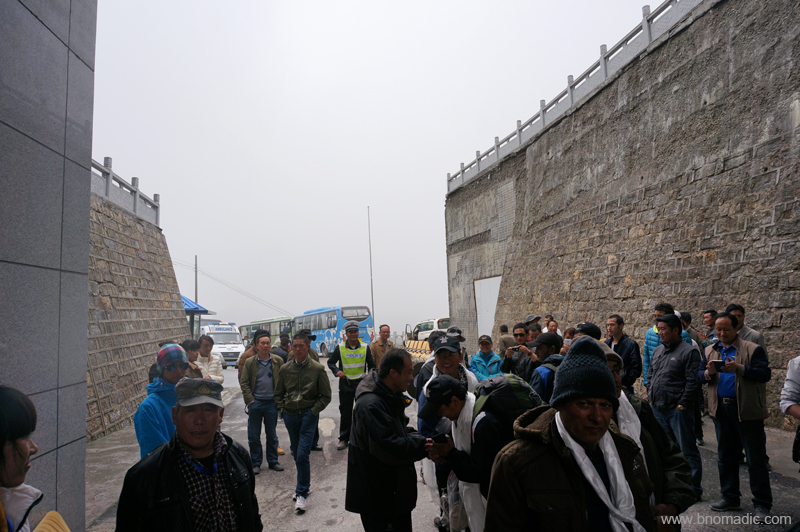
The Tibetan side from the no man’s land. More images from the region at Flickr Photoset
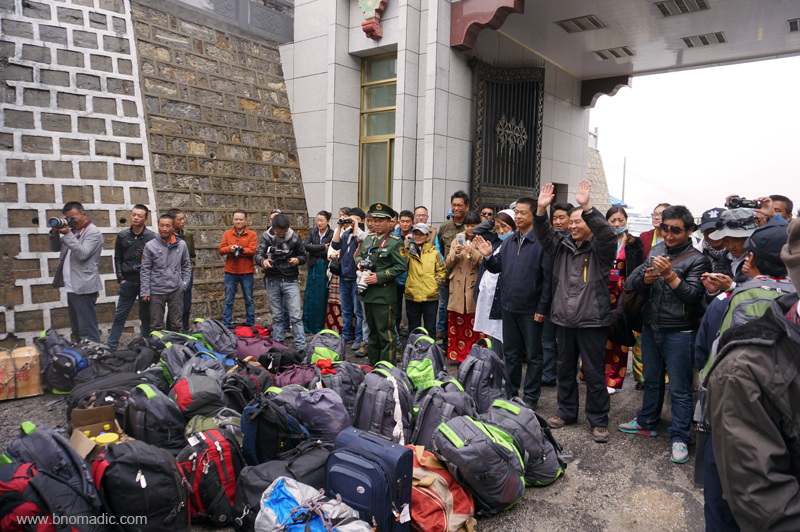
“We all bid you adieu” from the lovely Tibetans and Chinese. More images at Flickr Photoset
On the India side of the border, in the windy chill of the high-altitude mountain pass, the ITBP had hosted a high tea for us. The young officers of the Police Force keenly listened to our stories of the yatra. After some more formalities, we proceeded towards the Seventeenth Mile, Sherathang, where the ITBP had organised a formal function for us. The atmosphere was euphoric as we arrived at the acclimatisation centre at Sherathang. More stories from the yatra emerged; many of which even I wasn’t aware of. As if this wasn’t enough, the STDC guys briefed us that the Government of Sikkim has organised a formal reception for us next day at the Governor’s House Gangtok; as a tribute to mark the success of the first batch through this newly opened route. Almost all of the group members received that news with much interest and excitement. I rued the chance of exploring the hilly estate of Gangtok. Anyhow I was still hopeful about the evening.
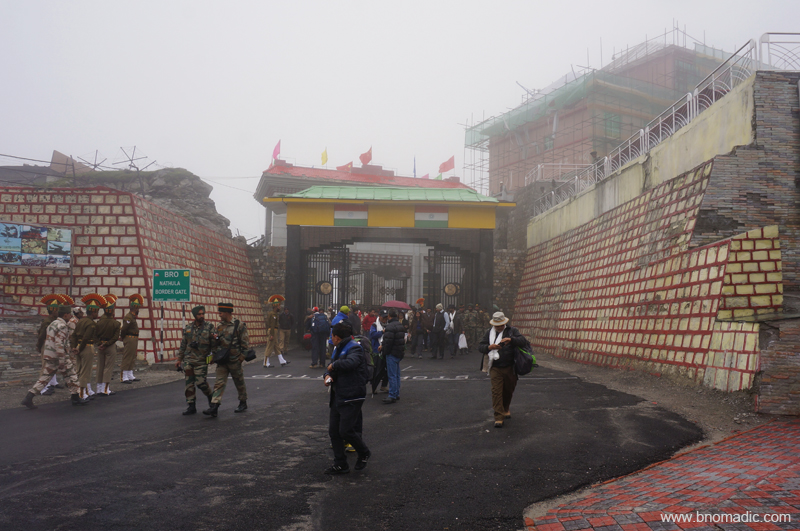
Getting “back to the country”. More images from the region at Flickr Photoset

The Sentinels of Nathula. Please visit Flickr Photoset for more images of the region
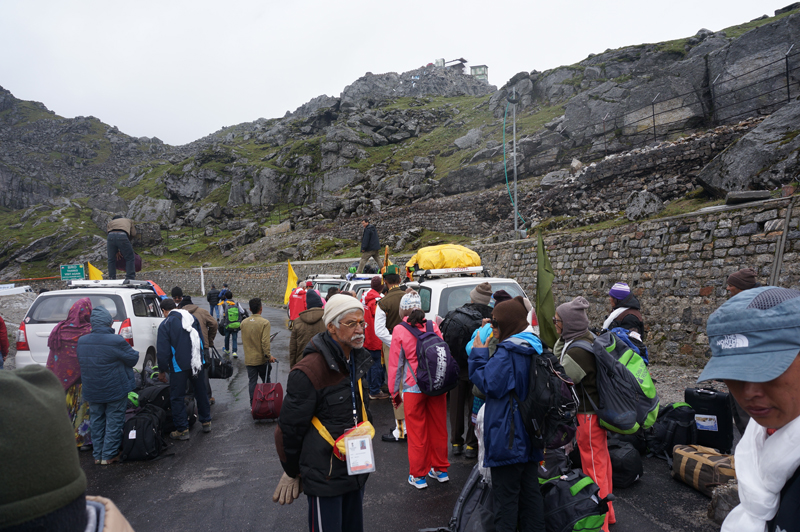
Sorting out luggage before proceeding to Gangtok. More images from the region at Flickr
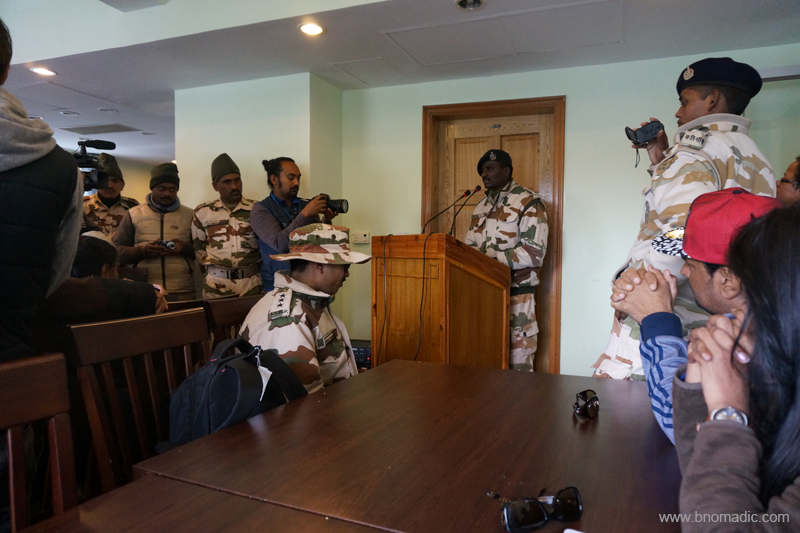
At Sherathang; exchanging wishes. More images from the yatra at Flickr Photoset

Just Tanned! (yours truly; not the officer). More images from the region at Flickr Photoset
Given the bad weather, the STDC arranged smaller vehicles for us to facilitate our transport to Gangtok from the pass. Our driver gave us the news of multiple landslides in the terrain but mercifully none obstructed our movement. With Kishore Da’s numbers playing in the car, our descent to the state’s capital was awesomely engaging for reasons more than one. The vibrant rain-washed hillside on the way looked even more natural and pristine. The celebrations wouldn’t just get over even till late evening that day as the locals kept thronging our guesthouse to greet us and get some first-hand information about our experiences. There was a sort of success and rejoicing throughout the hilly town.
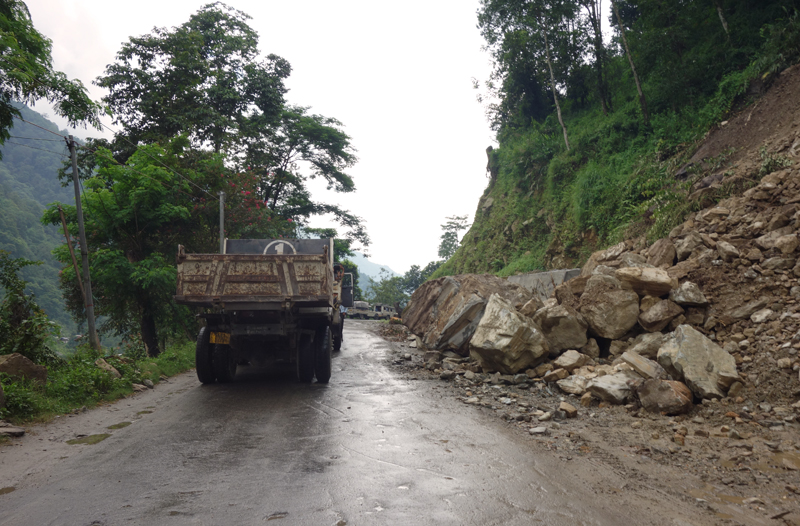
The road ahead. More images from the yatra/ region at Flickr Photoset
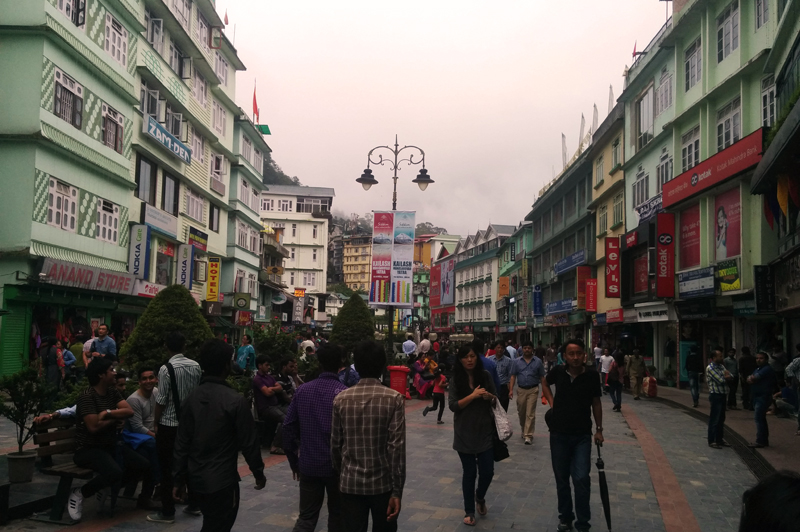
The MG Road market of Gangtok
Later that evening, we took a stroll in the market of MG Road. The famed market offers typical hill touristy stuff primarily comprising articles related to cold weather along with an extraordinary variety of home grown tea as well as articles related to Buddhist culture. Running short of time, I couldn’t reach much of the Lal market. I did not splurge much on anything except some copious amount and varieties of tea. My groupies seemingly bought everything under the roof; at least their swollen bags reflected that. The market square has some nice cafés looked after by locals. For those interested in nightlife, there are options too; frequented by local celebrities foot-tapping on hip-hop or techno or even college classics. I’d say that some of the best nights out happen spontaneously! *wink

The Governor of Sikkim, Sh Shriniwas Patil addressing the gathering at Raj Bhawan Of the many activities at the function, the best was the Jan Gan Man, the National Anthem played by the Sikkim Police band.
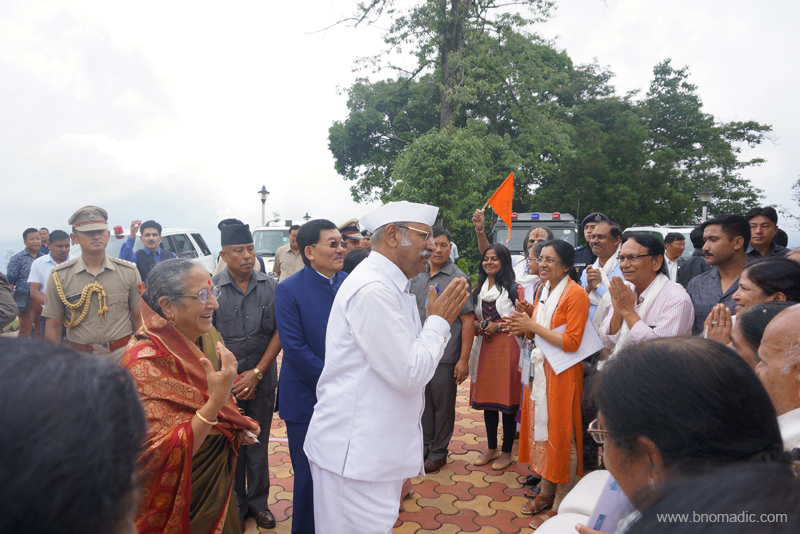
After the Group Photo. Please visit Flickr Photoset for more images of the region
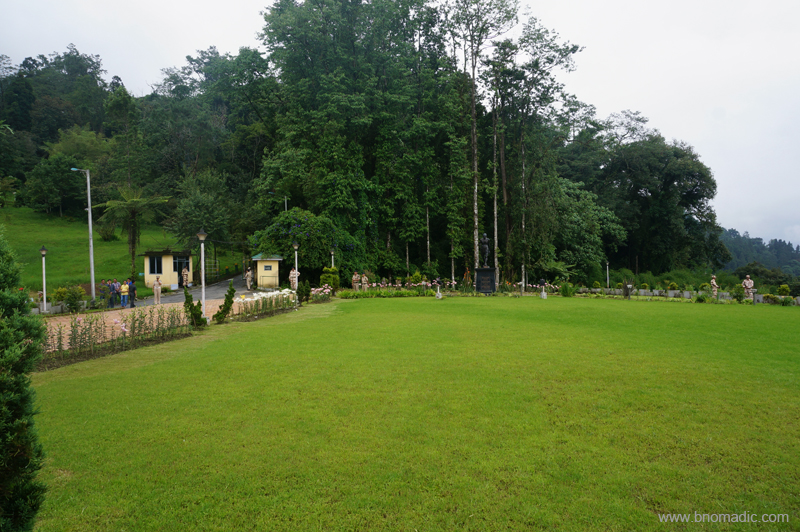
The sprawling greens of Raj Bhawan. More images at Flickr Photoset

Some more photo-ops with tanned and happy faces. More images at Flickr Photoset
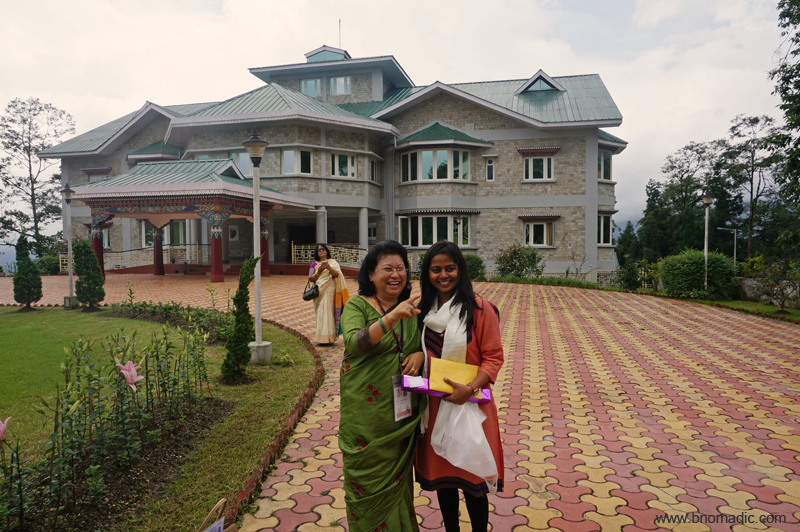
Confused. Three subjects. Many cameras. More images at Flickr Photoset
Following morning, the first batch was accorded an unprecedented welcome at Gangtok. It had the honour of being attended by the Governor, the Chief Minister along with the entire cabinet and state top machinery at the Governor’s House, the historic White’s Residency that has silently been observing the changing political landscape of Sikkim for over hundred years. After the speeches and a bara luncheon, the participants were presented with a souvenir by the Government of Sikkim. Another group photo with the chieftains; the final one, and we were packed off to the plains to board our flight to New Delhi.

Like a family; elated faces at the Raj Bhawan, Gangtok, Sikkim
Retracing the Trade Route to Nathula
The following post is a part of the “Kailash Mansarovar Yatra” Blog Series Into the Sacred Space. To read complete travel memoirs and trip report, please visit here.
Deeply elated and enriched with the experience of the divine Kailash Mansarovar, we left the geological wonder and began our journey back home. Even though, physically we had left the holy land but mentally we were forever initiated into inspirational and secure realms of the Sacred Space. The serenity of the landscape we saw on our return journey was overshadowed by the calmness of the holy region. On our journey back home to reach the Nathula, we followed precisely the same route as well as same fuel stops and campsites as we had initially. The journey seemed less rough but even more stimulating than our previous tête-à-tête with it.

The glittering Gurla Mandhata. Photo by Rita Willaert

The ancient Chiu Monastery by the Mansarovar. Photo by Rita Willaert
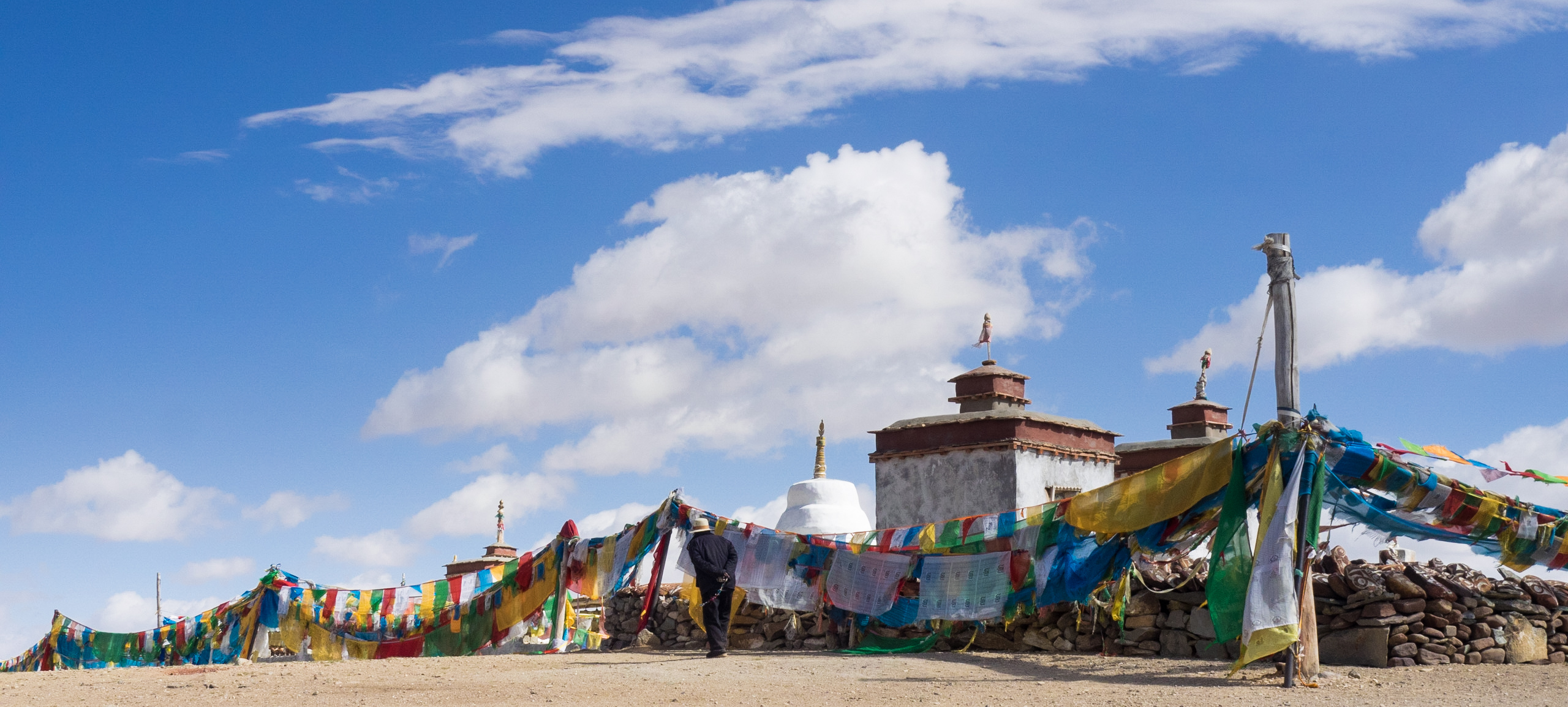
A different take from the same place, Chiu Monastery. Photo by Rita Willaert
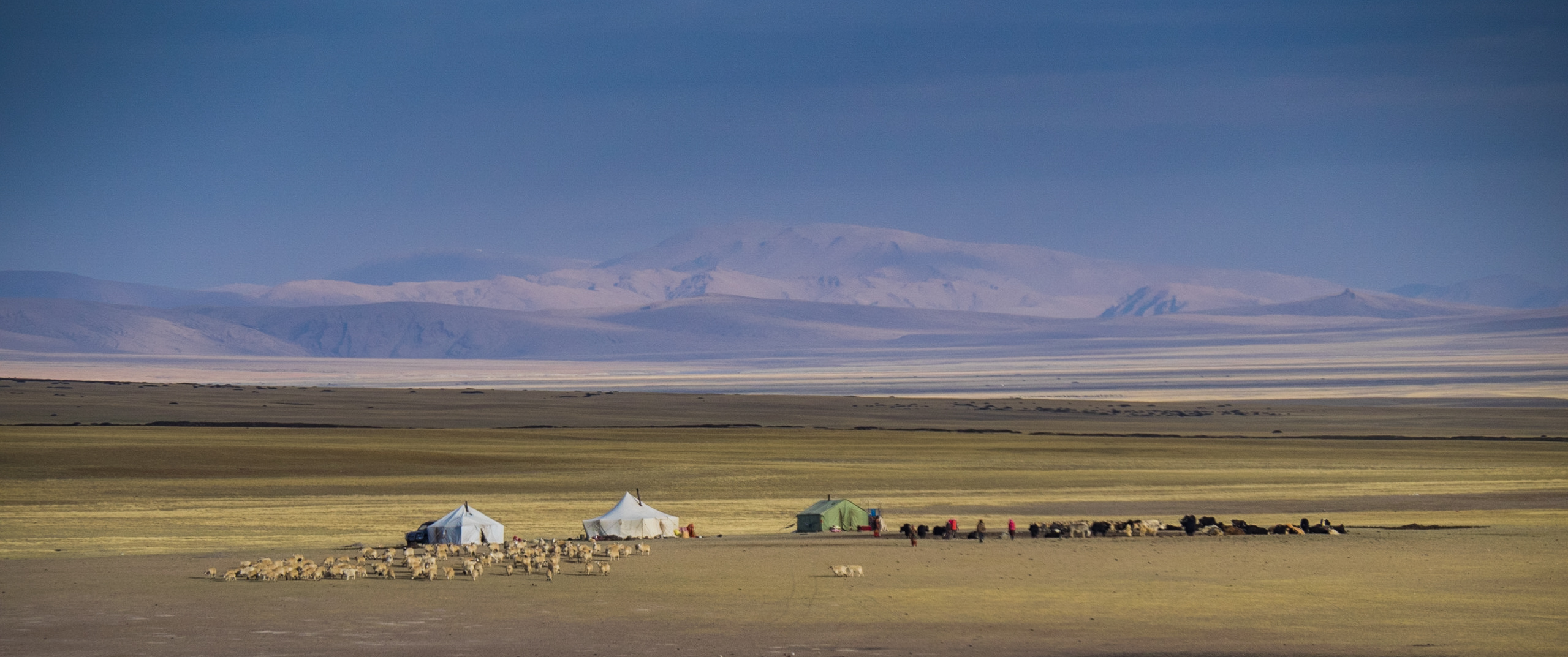
Modern Nomads at Barkha; in the shadow of Gurla Mandhata. Photo by Rita Willaert

Approaching the Mayum La. Please visit Flickr for more images of the region/ yatra

Steppes!; near Paryang. Please find more images from the region at Flickr Photoset
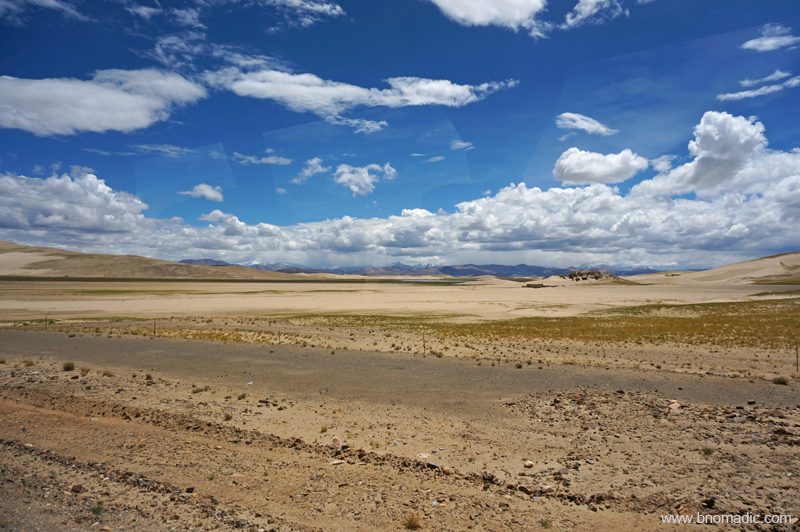
Semi-desert!; near Zhongba. More images from the region at Flickr Photoset

Greener Pastures!; near Saga. Please visit Flickr Photoset for more images of the region/ yatra

Desert!; Yarlung Tsangpo Chu also in the frame. More images from the region at Flickr
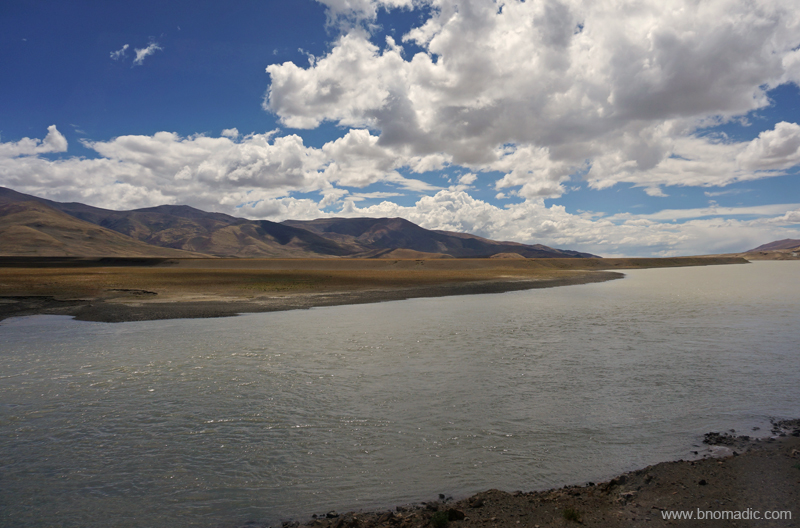
The Yarlung Tsangpo Chu (still infant); Please visit Flickr Photoset for more images from the region
A large part of the highway we were following had yet another historical context; trade economics. Depending upon the article to be traded, portions of the highway were popular as Silk Route, Tea Route of Horse Caravan Route. Life supporter for many communities, such routes continue to be sacred for many traders, even though, modernisation has undermined its commercial significance. After Lhasa; Yadong, Kangma, Gyantse, Shigatse, Lazi and Saga were the important trading centres in Tibet while in India; Almora and Kalimpong used to be the entrepôt of the Indo-Tibetan trade. With time because of the emerging politics, the focus too shifted.

High-altitude desert; Photo by Jen Reurink

An ancient religious site (forcefully ruined and restructured later). More images at Flickr Photoset

Wide open high-altitude plains. More images from the region at Flickr

Occasional shrubbery; feast for sheep. More images from the region at Flickr Photoset
Even though, the Tibetan civilisation is quite young than the Indian society flanking it from south as well as the Chinese empire spread along its north and eastern boundaries, yet it continues to have one of the most intriguing and fascinating cultures on the globe. Their mental complexity is second to none. Despite them being a peaceable race, the later part of previous century delivered a cruel fate to these hard-working people. Before the Chinese intrusion, this mysterious land of snows preferred to lock itself among the Himalayas; capturing the imagination of the west during all this while. For surveyors, explorers, traders or imperialists, it was a forbidden land of treasure. Those eyeing a spiritual quest advocated about a lost Shangri-La.

More grazing grounds; miles apart. More images from the region at Flickr Photoset

Some more Wild Asses, Kiangs on the Tibetan plateau. Photo by Rita Willaert
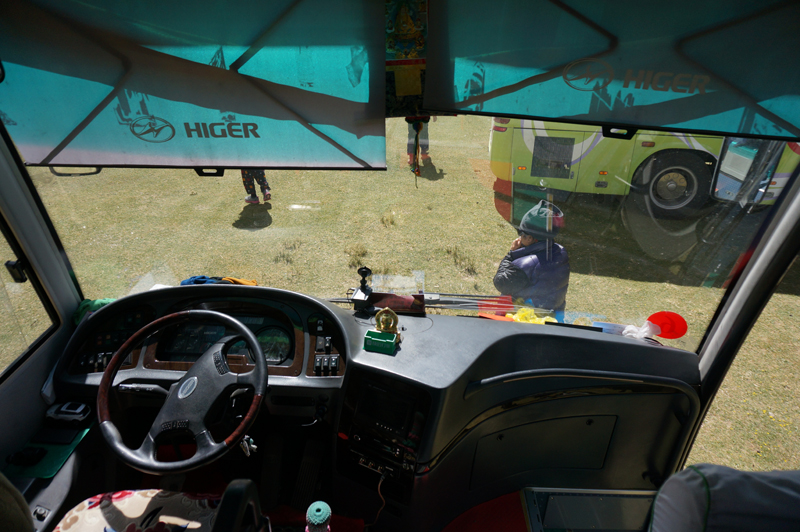
Left-hand drive. Please visit Flickr Photoset for more images of the region

One of the campsites for lunch. More images at Flickr Photoset

A typical fuel pump at a hard-to-imagine location. More images at Flickr Photoset

Photo by Rita Willaert
In his book Freedom in Exile, His Holiness the Dalai Lama writes, “Go to Tibet and see many places, as much as you can; then tell the world.” I couldn’t agree more with the fact that Tibet truly is one of the most remarkable natural wonders to visit on the planet. Apart from the stunning views and breath-taking high-altitude treks, the highland has intriguing monasteries, habits and a unique culture. Our expedition took us across glittering mountains and turquoise lakes over high mountain passes typically adorned with colourful prayer flags. Whether for meditation and prayer; monasteries or ruins of forts and hermitages; casual to professional mountaineering; or just for an overland road trip, the scope for adventure up here is limitless.

The mighty Yarlung Tsangpo Chu. More images from the region at Flickr Photoset

View from a high-altitude pass near Saga. More images from the region at Flickr Photoset
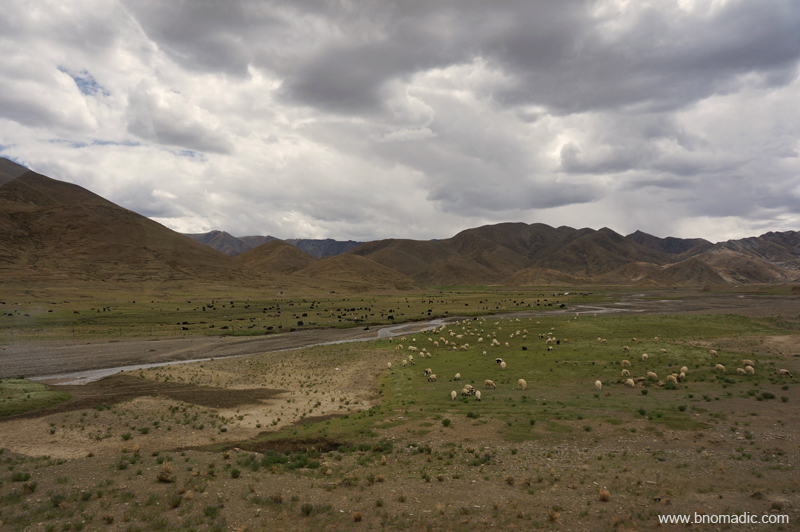
Another scarce pastureland near Sangsang. More images from the region at Flickr Photoset
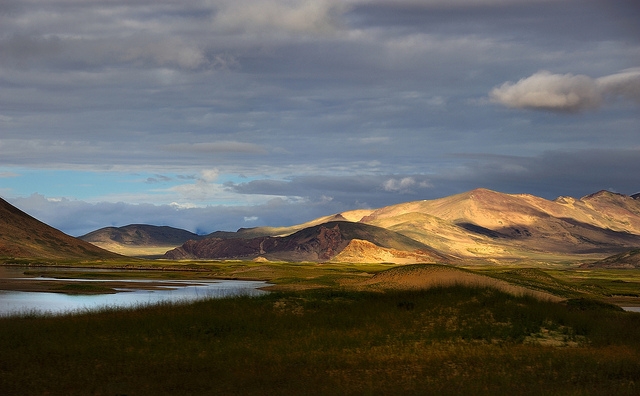
Somewhere in the Yarlung Tsangpo Valley. Photo by Jen Reurink
Figuratively speaking, our Tibetan sojourn was in the reverse mode. Travelling through Tibet, I am persistently thinking of the political situation of the country. Geographically the region commands a very large area but has always been sparsely populated. Today, the area is commanded by Chinese military with its control centre located at Beijing, almost 3,700 km from its capital at Lhasa. The Tibetans have been forced to become a minority in their own homeland. Although, the Chinese have conferred the country with the label of Tibet Autonomous Region (TAR); independence here is only imaginary with even minute dissent against the administration being unfeelingly supressed.
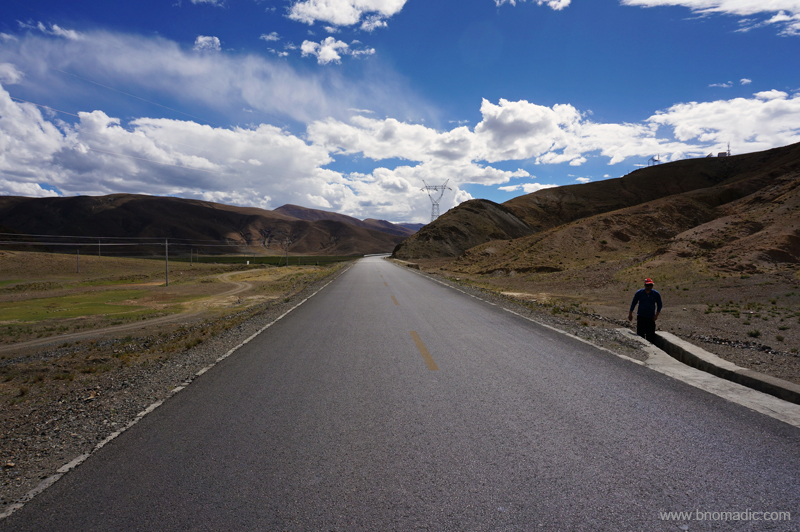
G219, a little before Lazi. More images from the region at Flickr Photoset
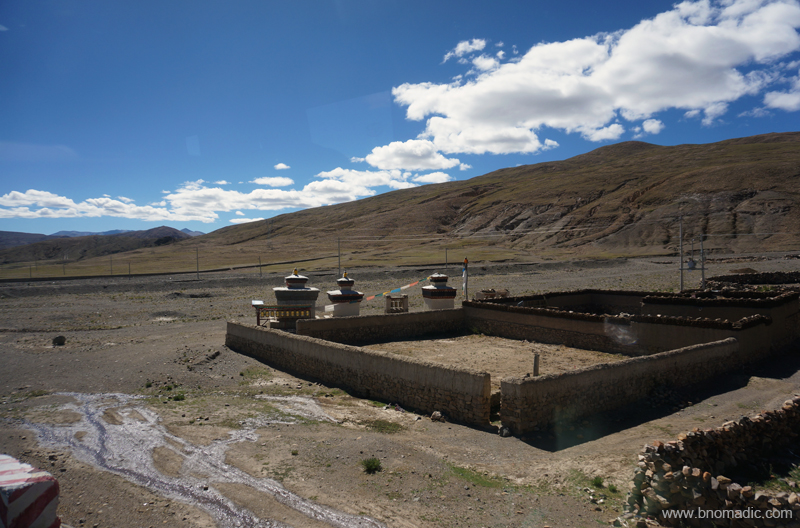
Through the Sakya Territory. More images from the region at Flickr Photoset
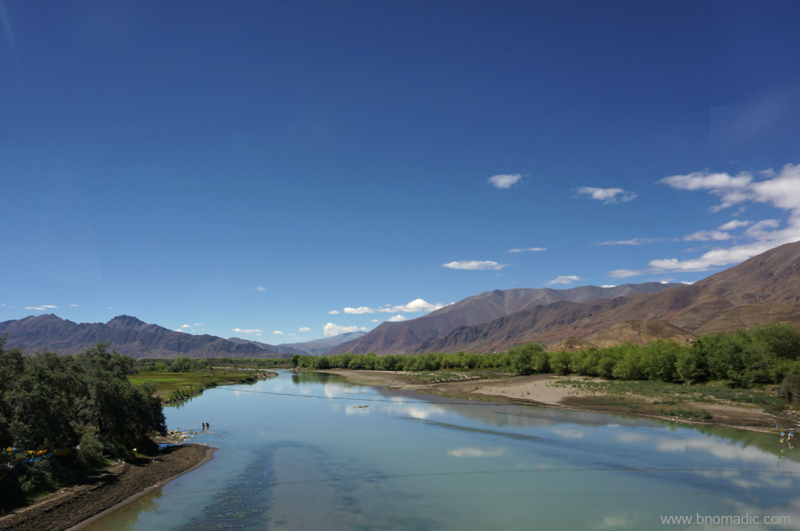
A tributary to the Brahmaputra (Yarlung Tsangpo Chu). More images at Flickr Photoset

Bike accessory headgear put to multiple use. More images at Flickr Photoset
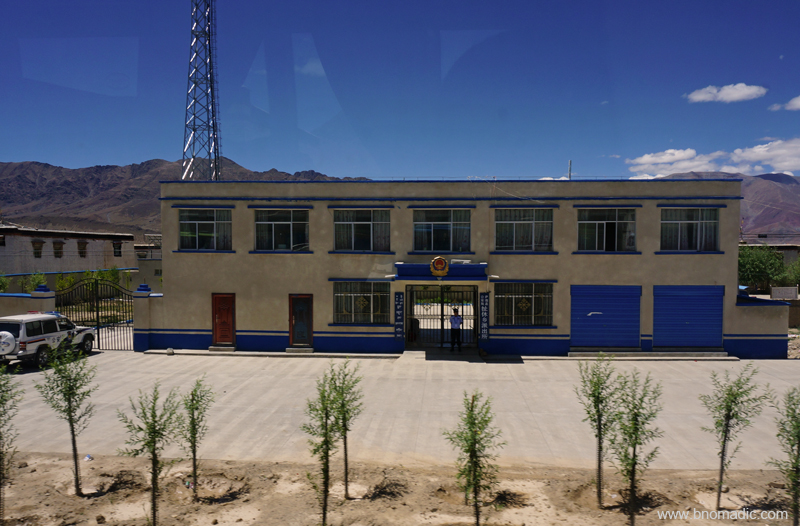
A typical Police Station. Please visit Flickr Photoset for more images of the region
As momentary travellers, we had limited window to observe the social and cultural undercurrents of Tibet. Nevertheless, with their concrete colonies typically bedecked by the flag of China instead of usual prayer flags and police or army installations springing up out of nowhere, the villages and townships along the highway offered some evidence of ongoing changes. The labour force engaged along the highway or in such settlements comprised mostly Tibetans; their superiors mostly Chinese. Taking a walk in the streets, one would smell enough indication of invasive control by a rather dictatorial regime that often governs with arrogance, insensitivity or even stupidity.
Much of the devastation happened between 1950 and 1970 when the Chinese seized control of the plateau and in the process drove the Dalai Lama along with nearly 100,000 Tibetans into exile. It was around this time when the new regime steadily pulled apart a majority of the cultural as well as historical heritage of Tibet under the garb of a revolution. The political leader of the newer rule, Chairman Mao replaced the images of the traditional deities with his portrait. However, with the onset of some global sense coupled with increasing tourism interest and the doors to Tibet for outsiders were opened in the mid-1980s but by that time everything presentable was in ruins.
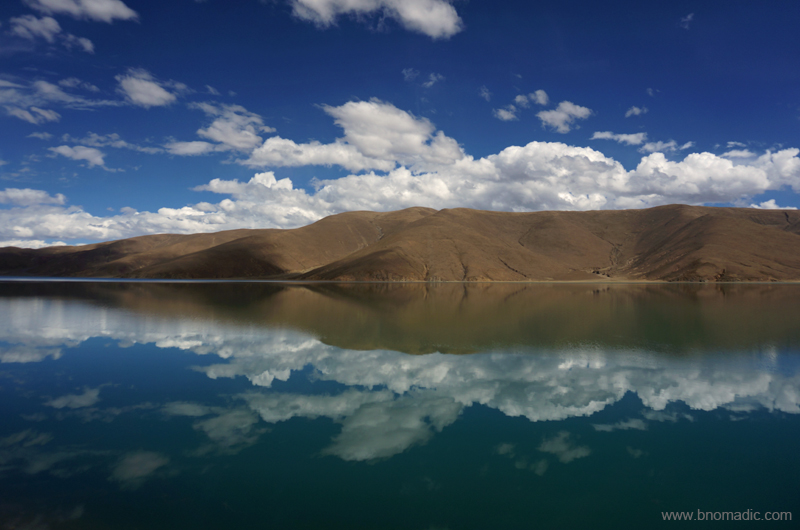
The calm Lang Tso; just before Lazi or Lhatse as administration would call it. More images at Flickr

Batch One Yatris with Chinese and Tibetan staff. More images at Flickr Photoset
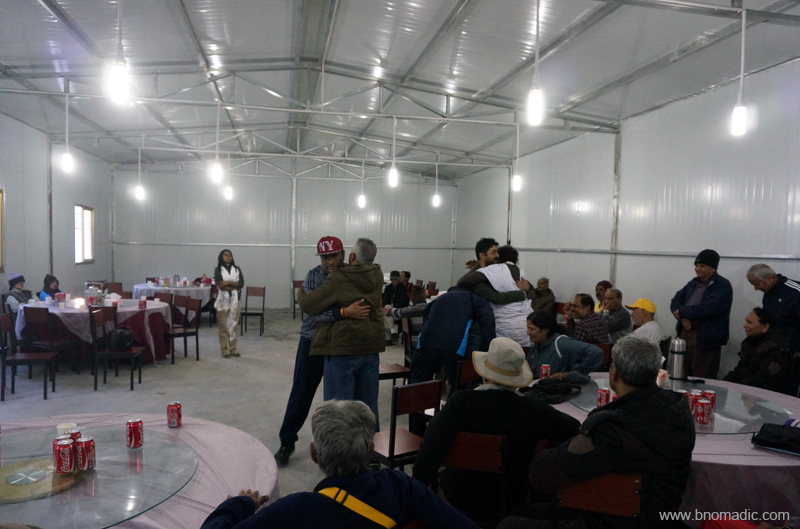
Getting emotional and all…Please visit Flickr Photoset for more images
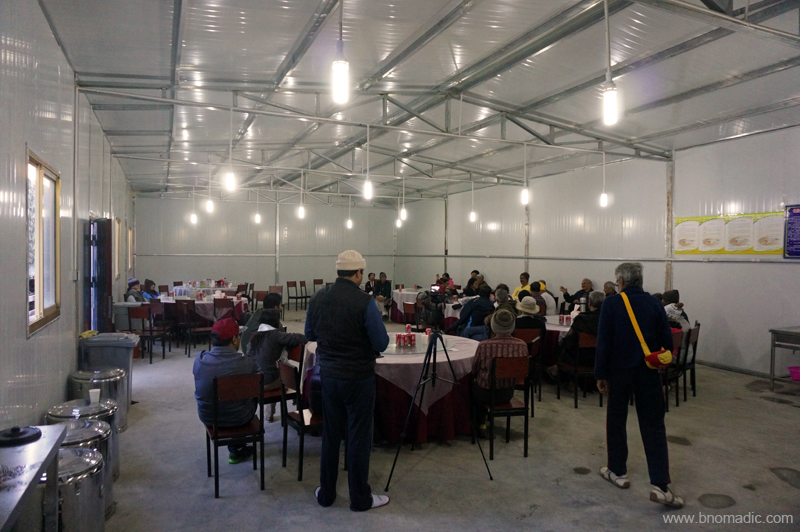
Some cultural extravaganza. Please visit Flickr Photoset for more images
With time business interests of the Chinese diversified and the investment came. But as predicted, development happened on China’s terms. With a slew of infrastructural projects, new hotels, mushrooming restaurants or bars mostly looked after by Chinese benefitting the Chinese; keen observers called it the second invasion. Lhasa is booming, modernised or rebuilt and so are many of the earlier trade junctions spread across the highland. Most multi-storied apartments, I noticed, remains unoccupied. Once a remote sanctuary of hardy travellers, it is now the Chinese tourists who throng the Potala or wildest of treks. With every passing month Tibet is changing fast; looks less and less like itself. Someway, the Tibetan pilgrims across the land are once again picking up the rhythm, chanting mantras and swinging their prayer wheels in isolation. Led by dollar hungry tourism initiatives, many monasteries have been restored across the highland and a limited religious freedom too has been granted.
The underlying genuineness of the situation is that Tibet continues to be a spirited country fortified by a unique culture and rocklike faith. It is a sort of place that might change the way you see or travel the world and that will remain with you for years to come. And that’s certainly the meaning of the very best of travel!
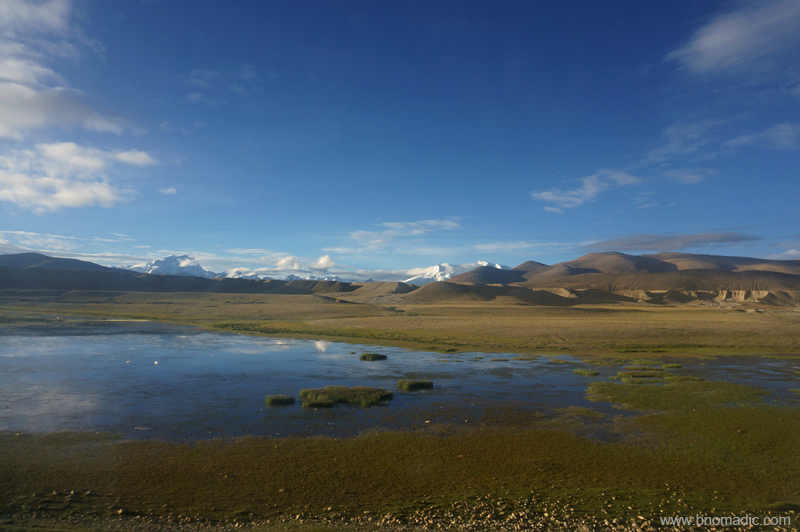
Marshy tract near Kangmar county border. More images at Flickr Photoset
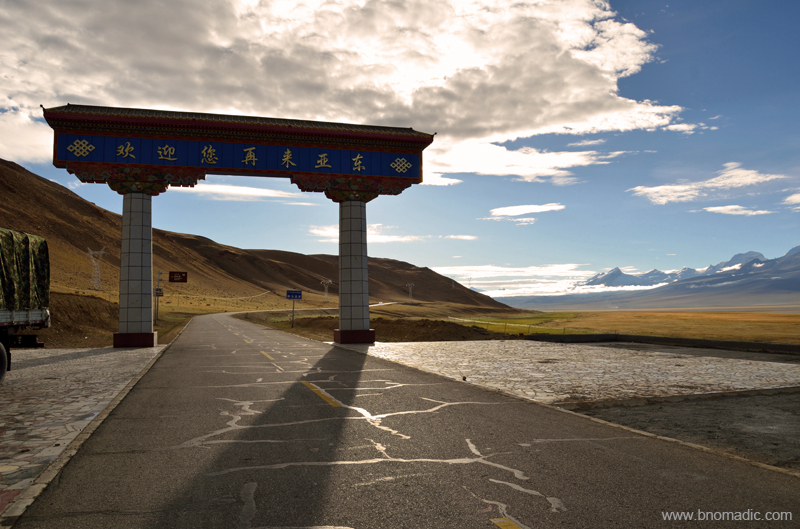
The welcome gate to the Kangma county of Shigatse Prefecture. More images at Flickr Photoset

Snowy peaks near the border of Kangma county. More images from the region at Flickr Photoset

The Chomolhari; Its sheer north-face rises over 2,700 m above the barren plains just before Yadong Valley. More images from the region at Flickr Photoset

The infant Amo River before Chumbi Valley. More images from the region at Flickr Photoset

The Amo Valley. Please visit Flickr Photoset for more images of the region/ yatra

The green Chumbi Valley and the road to the Nathula. More images at Flickr Photoset

Negotiating a landslide just before Nathula. More images at Flickr Photoset
In about four days we were back at our first station in Tibet, Kangma township. A mind stirring fortnight-long excursion into the trans-Himalayan region was coming to an end. By the time we reached the Tibetan end of the yatra at Kangma, our groupies were overjoyed to have undertaken the trip. At Kangma, our Liaison Officer organised a small thanksgiving event for the Chinese management who travelled with us and helped us in organising this yatra. Even though I joined this program very late but from what I remember I saw yatris embracing each other in acknowledgement of having completed the most sacred pilgrimage. They hold each other as brothers and close friends, though most of them would never meet again.
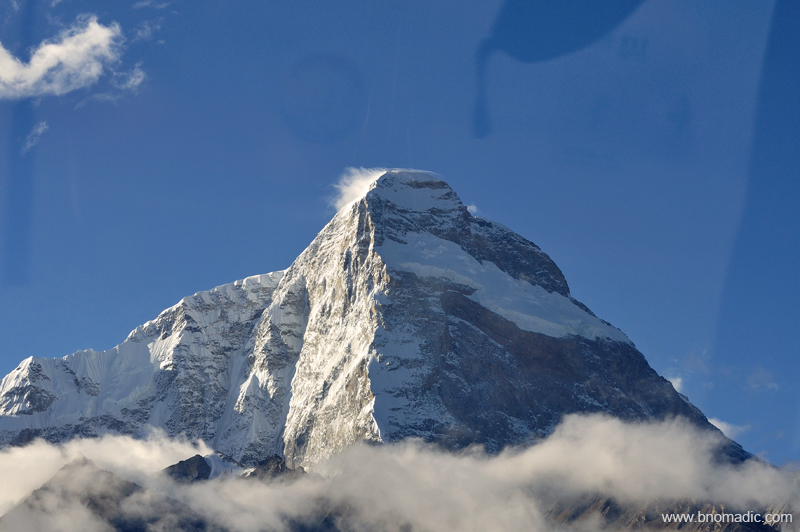
The 7326m Mt Chomolhari. More images from the region at Flickr Photoset







 bNomadic